| Ultra-light core | 29–48 kg/m³
3–6 mm nominal cell size | Low-load interior panels, fairings, doors, covers, and non-structural cabin components. | Choose when minimum mass is the primary objective and the panel has adequate face-sheet stiffness and local reinforcement. |
| Light structural core | 48–80 kg/m³
3–6 mm or 6–10 mm cell size | General aerospace, rail, marine, and transport sandwich panels requiring a balance of weight, shear support, and processability. | A suitable starting range for many lightweight panels; confirm compression, shear, and flatwise tensile properties for the final design. |
| Medium-density core | 80–120 kg/m³
3–6 mm nominal cell size | Floor panels, equipment platforms, access panels, bulkheads, and areas exposed to higher concentrated loads. | Use where improved core stability and local load resistance are more important than the lowest possible core mass. |
| High-density core | 120–160 kg/m³
3–6 mm nominal cell size | High-load panels, hard points, heavy-duty partitions, and regions requiring greater compressive and shear capability. | Verify that the additional core mass is justified; use inserts or local doublers when loads are highly concentrated. |
| Fine cell option | 3–4 mm
Usually selected with medium or high density | Improved surface conformity, better support for thin face sheets, and reduced risk of print-through on curved panels. | Preferred for tighter radii, thin skins, detailed contours, and applications where surface quality is important. |
| General-purpose cell option | 5–6 mm
Broad processing range | Common compromise between drape, resin access, panel weight, and fabrication efficiency. | Use for flat or moderately curved panels when no special contouring requirement dominates the design. |
| Coarse cell option | 8–10 mm
Often used with lower or medium density | Large-area panels where fast cutting, low core mass, and efficient material coverage are priorities. | Check face-sheet stability, unsupported span, local indentation, and surface telegraphing before specifying a coarse cell. |
| Hot-wire or heated blade cutter | Temperature-controlled cutting system; clean, non-crushing contact | Fast trimming of straight edges and repeatable cutting of honeycomb blocks or sheets. | Use controlled heat and ventilation appropriate to the resin system; avoid excessive heat that can damage cell walls or contaminate bonding surfaces. |
| Band saw or fine-tooth saw | Fine blade, rigid guide, dust extraction, and adjustable feed rate | Accurate straight cuts, thickness reduction, and preparation of larger core sections. | Support the core continuously during cutting to reduce tearing, crushing, and out-of-square edges. |
| Oscillating knife or CNC knife cutter | Programmable cutting path with low-force oscillating blade | Repeatable profiles, apertures, curved edges, and nesting of multiple panel shapes. | Best for clean, low-compression cutting; use sacrificial backing and verify kerf compensation for tight tolerances. |
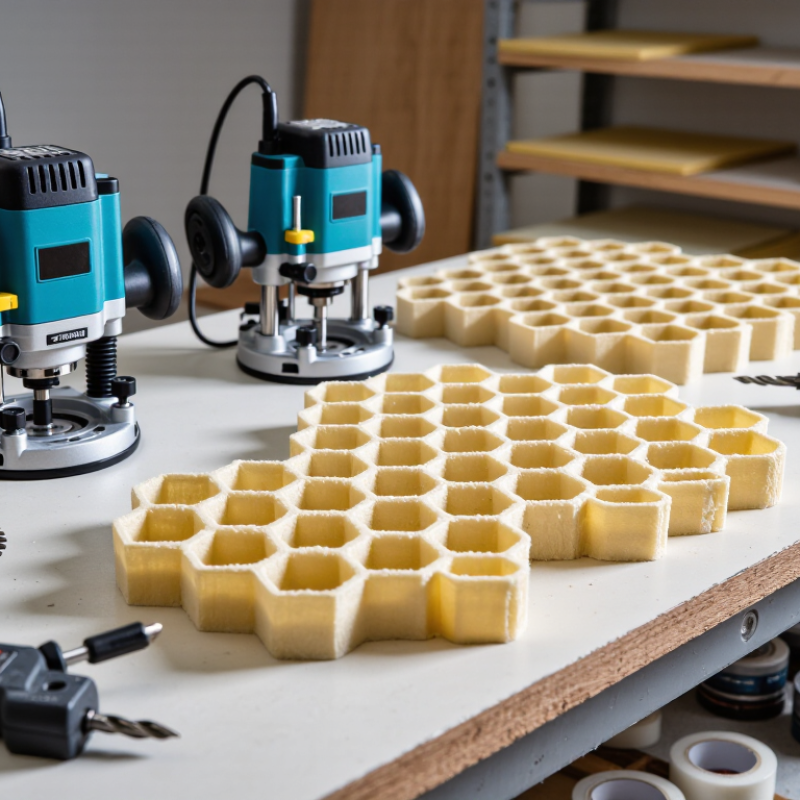
| Router with dust extraction | Sharp carbide tooling, shallow passes, controlled spindle speed | Edge trimming, pockets, rebates, scarf preparation, and insert cavities. | Use light passes and full extraction because aggressive routing can fracture cell walls and generate fine particulate. |
| Core splicing and joining tool | Alignment jig, low-pressure roller, and compatible film or paste adhesive | Joins smaller core pieces into larger panels while maintaining cell alignment. | Control adhesive quantity and cure conditions; excessive adhesive adds mass and may restrict cell drainage or ventilation. |
| Core contouring tool | Contour jig, compression fixture, or controlled kerf-cutting setup | Forms aramid honeycomb to single-curvature or compound-curvature surfaces. | Match the method to cell size and density; fine cells generally conform more easily, while high-density cores require higher forming control. |
| Adhesive application equipment | Notched spreader, metering roller, or calibrated dispensing system | Applies film, paste, or liquid adhesive uniformly to the core or face sheets. | Follow the adhesive supplier’s recommended film weight, open time, pressure, and cure schedule; avoid over-wetting the core. |
| Vacuum-bagging equipment | Vacuum pump, bag film, breather, release film, sealant tape, and vacuum gauge | Provides uniform consolidation during bonding and reduces voids in sandwich laminates. | Check leak rate before cure and use a pressure level compatible with the core, face sheets, and tooling configuration. |
| Compression or cure fixture | Flat, dimensionally stable tool with controlled pressure and temperature | Maintains panel thickness, alignment, and bond-line consistency during adhesive curing. | Provide adequate caul support and avoid localized pressure that can crush the honeycomb cells. |
| Dimensional inspection tools | Calipers, thickness gauge, straightedge, angle gauge, and digital scale | Checks core thickness, cell size, squareness, mass per unit area, and finished-panel dimensions. | Measure several locations because honeycomb thickness and cell geometry can vary across a sheet or block. |
| Density verification | Conditioned specimen, precision balance, and measured volume | Determines apparent core density using mass divided by volume. | Record specimen dimensions, moisture or conditioning state, and whether adhesive, coating, or scrim is included. |
| Compression test reference | ASTM C365/C365M or an equivalent validated method | Measures flatwise compressive strength and modulus of sandwich core material. | Use the same specimen orientation, conditioning, and reporting basis when comparing different density grades. |
| Shear test reference | ASTM C273/C273M or an equivalent validated method | Measures core shear strength and shear modulus in the selected direction. | Important for floors, beams, panels, and components where face sheets transfer bending loads through the core. |
| Sandwich flexural test reference | ASTM C393/C393M or an equivalent validated method | Evaluates the bending response of the complete face-sheet/core sandwich construction. | Test the actual face-sheet, adhesive, core density, cell size, and thickness combination rather than relying only on core data. |
| Bond integrity inspection | Visual inspection, tap testing, ultrasonic inspection, or thermography | Detects disbonding, voids, crushed zones, resin starvation, and incomplete adhesive transfer. | Select the inspection method according to panel thickness, skin material, accessibility, and required quality level. |