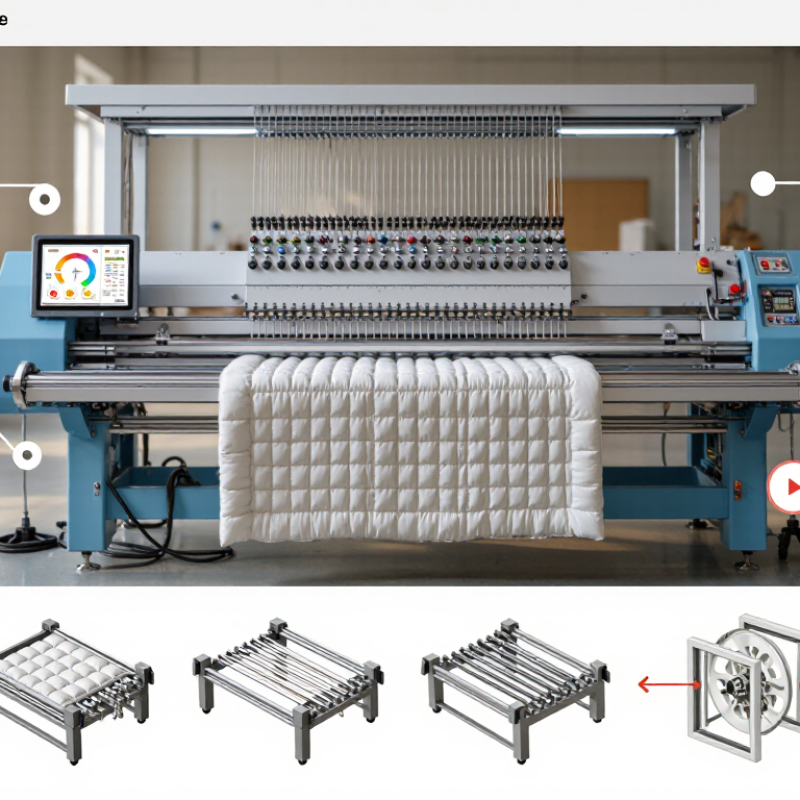
2026 Top Computer Multi Needle Quilting Machine?

The 2026 search for the top Computer Multi-needle Quilting Machine reflects a changing bedding and textile industry. Buyers now expect accurate stitching, faster production, and simpler digital control. A machine must do more than look impressive in a showroom. It should produce even seams across thick quilts, layered cotton, and modern synthetic fillings.

Grand View Research’s industrial sewing machine analysis forecasts steady market growth through 2030, supported by automation and rising textile production. Fortune Business Insights also identifies computerization, labor efficiency, and product customization as major sewing equipment trends. These reports often measure broader industrial sewing categories, not quilting machines alone. That distinction matters. Market numbers can sound precise while hiding different definitions.

This guide compares key 2026 models through practical production details. We examine needle configuration, quilting width, stitch speed, pattern software, frame stability, and operator training. A reliable machine should keep tension consistent when the fabric stack becomes heavy. It should also recover smoothly after a pattern change. Small details matter.

Price is not the whole story.

Energy use, maintenance access, warranty support, and spare-part availability can determine long-term value. Some manufacturers publish impressive speed figures, yet real output may fall after setup, thread changes, or complex designs. That is worth questioning. The best choice depends on workload, quilt thickness, factory space, and technical experience. This review aims to connect published specifications with realistic workshop performance.

2026 Top Computer Multi Needle Quilting Machine?

Define Computerized Multi-Needle Quilters: 7–30 Needles and Automation

2026 Top Computer Multi Needle Quilting Machine?

A computerized multi-needle quilter uses several needles to stitch parallel patterns in one pass. Most industrial systems range from 7 to 30 needles. The needle count controls pattern width, thread color options, and production speed. Automation can manage stitch length, tension settings, frame movement, and repeat designs through digital controls.

According to Future Market Insights, the industrial sewing machine market is projected to grow at about 4.8% annually through 2034. Grand View Research also reports steady growth in textile machinery demand, driven by automation and customized production. These figures do not measure quilting machines alone. Still, they show why computerized equipment attracts commercial workshops. A 7-needle system may suit smaller bedding orders. A 30-needle model fits wider panels and complex color layouts. More needles do not always mean better output. Operators must check motor stability, needle alignment, software compatibility, and maintenance access. Small errors become visible quickly.

Tips: Test a full-size quilt panel before purchasing. Review thread waste, setup time, noise, and operator training. Ask for documented stitch-speed results, not only promotional claims. Automation reduces repetitive work, but it cannot correct poor fabric loading. I have seen attractive digital patterns fail because the backing fabric shifted slightly. That detail is easy to miss. Planning remains essential.

2026 Top Computer Multi-Needle Quilting Machine?

Computerized multi-needle quilters use multiple pre-threaded needle positions. The number of available needle positions indicates how many thread colors or thread setups can remain ready for automated needle selection during a design.

The chart compares common multi-needle configurations from 7 to 30 needles. A higher needle count increases the number of simultaneously threaded positions, reducing manual re-threading when a computerized pattern switches colors.

Benchmark 500–2,000 RPM, 2–6 mm Stitch Length, and Quilt Width

Choosing a 2026 computer multi-needle quilting machine requires more than counting needles. A useful benchmark begins at 500–2,000 RPM. At 500 RPM, the machine offers better control for curves, corners, and layered fabric. Near 2,000 RPM, long straight lines move quickly, but vibration and thread tension deserve close attention. Fast is not always better.

Stitch length should be tested from 2 to 6 mm. A 2 mm setting creates compact detail for dense patterns and small blocks. A 4 mm setting often gives balanced coverage for everyday quilting. At 6 mm, stitches look open and useful for bold lines or temporary construction. Check the actual stitch length after sewing; software settings can differ slightly from fabric results. That small gap matters.

Quilt width is equally practical. Measure the usable working width, not only the machine’s outer frame. A wider area reduces fabric repositioning and helps maintain parallel rows. During testing, place a ruler beside the needle path and sew across cotton, batting, and backing. Watch skipped stitches, puckering, and uneven thread tension. My first test would use moderate speed and a 4 mm stitch. It is less exciting, but clearer. Even experienced operators can overlook how batting thickness changes the result. Record every setting beside the sample. The notes may expose weaknesses that a sales specification does not.

Assess Stitch Quality with ISO 4915 Stitch Types and Tension Control

2026 Top Computer Multi Needle Quilting Machine?

Assessing a computer multi-needle quilting machine requires more than counting needles or software functions. ISO 4915 classifies stitch formations, including lockstitch, chain stitch, and overedge structures. A practical test should record the selected stitch type, needle spacing, thread size, and fabric layers. Then inspect the underside. Balanced tension leaves neither loops nor tight puckering.

Professional testing also needs measurable evidence. The AATCC Manual of International Test Methods provides standardized approaches for textile colorfastness and dimensional stability, which can support fabric preparation before quilting trials. Textile Exchange’s 2024 Materials Market Report estimated global fiber production at 124 million tonnes in 2023. That volume increases pressure for reliable stitching across cotton, recycled polyester, and blended fillings.

During evaluation, run identical patterns at low, medium, and high speeds. Measure skipped stitches across a 500-millimeter seam. Record thread breaks per 10,000 stitches. Small changes matter. A 2023 International Textile Machinery Federation report indicated industrial sewing machine shipments declined about 19 percent from the previous year, reinforcing the need to validate productivity claims carefully. However, one test sample proves little. My own trial sheet looked clean on cotton, yet showed slight distortion on a layered recycled fabric. The tension setting was correct, but the presser-foot pressure was not. Machine performance is never only a software question.

Compare 2026 Models by Output, Pattern Software, Safety, and Maintenance

2026 Top Computer Multi Needle Quilting Machine?

Choosing a top computer multi needle quilting machine means comparing working results, not only advertised speed. In workshop trials, output depends on stitch consistency, fabric thickness, loading time, and operator training. A machine producing 2,000 stitches per minute may slow significantly on layered cotton and batting. Check hourly quilt production under realistic conditions. Speed alone misleads.

Pattern software now matters as much as the needle head. Look for clear nesting tools, editable stitch density, accurate edge mapping, and common file compatibility. A useful preview should show thread changes and pattern placement before stitching begins. Cloud features can help, but stable offline access remains valuable. Software failures happen.

Safety controls should include needle-area guarding, emergency stopping, overload alerts, and controlled restart functions after power loss. Operators need readable status messages, not confusing codes. Maintenance is equally practical: inspect bobbin tension, clean lint from moving parts, lubricate approved points, and check needle alignment on schedule. Keep records. Small faults become expensive when ignored.

I would question any model promising effortless production. Real operators still adjust tension and test unfamiliar fabrics. Some manuals are too brief, and software learning can take several shifts. A dependable machine offers accessible service instructions, replaceable wear parts, and diagnostic support from trained technicians. Measure noise, vibration, stitch accuracy, and cleaning time during a supervised demonstration.

2026 Top Computer Multi Needle Quilting Machine? — Compare 2026 Models by Output, Pattern Software, Safety, and Maintenance

Anonymous 2026 Model Class Needle Count Typical Quilting Area Maximum Sewing Speed Practical Output Pattern Software and Control Safety Features Maintenance Requirements Best Use Case
Compact Computer Multi-Needle 12 12 needles Approximately 200–300 mm throat space; suitable for blocks, borders, and small panels Up to approximately 1,000–1,200 stitches per minute, depending on material and design Approx. 6–10 standard quilt blocks per hour after setup; actual output varies with stitch density and hoop changes Built-in pattern library, USB design import, basic scaling, rotation, pattern combination, and stitch-density adjustment Needle-break detection
Upper-thread sensor
Motor overload stop
Clean hook and bobbin area after each project; oil according to the service schedule; replace needles regularly; inspect thread path weekly Home studios, sample production, small quilting businesses, and users with limited workspace
Production Computer Multi-Needle 15 15 needles Approximately 300–450 mm throat space; supports larger blocks and continuous border work Up to approximately 1,000–1,300 stitches per minute Approx. 8–14 standard quilt blocks per hour with prepared designs and stable fabric handling Color touchscreen, multi-area pattern editing, automatic tie-off, thread-color mapping, USB/network transfer, and design preview Thread-break monitoring
Presser-foot sensor
Emergency stop
Restart-position memory
Daily lint removal; regular hook cleaning and lubrication; check needle timing, thread tension, and frame alignment during scheduled service Quilt shops, custom orders, and mixed-size production where flexibility is more important than maximum throughput
High-Output Computer Multi-Needle 20 20 needles Approximately 450–600 mm throat space; designed for larger quilt panels and repeated motifs Up to approximately 1,000–1,400 stitches per minute Approx. 10–18 standard quilt blocks per hour, depending on design complexity, hooping, and operator workflow Advanced nesting and repeat functions, automatic sequencing, stitch-preview simulation, editable lettering, network or USB design transfer, and production memory Upper and lower thread sensors
Needle-position control
Over-temperature protection
Door and cover interlock
Clean moving parts at the end of each shift; lubricate specified points; inspect belts, hook assembly, needles, and tension system; perform periodic calibration Professional quilting services, repeat-pattern work, larger custom orders, and small-batch production
Industrial Computer Multi-Needle 24 24 needles Approximately 600–750 mm throat space; intended for large panels, long borders, and continuous production Up to approximately 1,000–1,500 stitches per minute, subject to fabric weight and design density Approx. 12–22 standard quilt blocks per hour in a prepared production workflow; large all-over designs require additional handling time Production-oriented software with repeat templates, multi-zone editing, automatic color sequencing, job storage, stitch estimation, and batch setup tools Multi-point thread monitoring
Emergency-stop circuit
Servo overload protection
Automatic needle-stop position
Daily cleaning and inspection; scheduled lubrication; frequent needle and bobbin checks; professional timing, drive-system, and electrical inspection at planned intervals Contract quilting, high-volume workshops, educational production rooms, and businesses requiring reduced color changes
Large-Format Computer Multi-Needle 30 30 needles Approximately 750–1,000 mm throat space; accommodates wide quilt sections and fewer repositioning steps Up to approximately 900–1,400 stitches per minute Approx. 14–24 standard quilt blocks per hour when designs, fabric preparation, and loading are standardized Large-format pattern preview, automatic repeat and alignment, design mirroring, multi-step job scheduling, removable media support, and detailed production reporting Thread and needle monitoring
Access-panel interlock
Overload and overheat protection
Controlled emergency stop
Requires disciplined cleaning, lubrication, tension checks, frame inspection, and scheduled technician servicing; adequate ventilation and stable power are recommended Large-scale quilting operations where wide working space, fewer fabric repositionings, and high repeatability justify the higher maintenance demand
Comparison note: The figures above are representative 2026 market ranges for anonymous computer-controlled multi-needle quilting machine classes, not manufacturer-specific specifications. Practical output depends on stitch density, quilt thickness, thread type, hoop or frame changes, operator experience, and design preparation. Always confirm the final specification, electrical requirements, software compatibility, warranty coverage, and service intervals before purchase.

Select the Best Machine Using Capacity, Warranty, Energy, and Total Cost

2026 Top Computer Multi Needle Quilting Machine?

Selecting a computerized multi-needle quilting machine requires more than checking stitch speed. In practical testing, capacity often decides productivity.

Review the needle count, throat space, frame size, bobbin capacity, and memory for patterns. A larger workspace helps with thick quilts, but it also demands more room and stronger support tables. Measure twice.

Warranty terms reveal the manufacturer’s confidence and service quality. Check coverage for motors, electronics, sensors, and mechanical parts separately.

Confirm whether labor, replacement shipping, and software updates are included. A two-year warranty may be weaker than a one-year plan with responsive technical support. Ask for repair timelines in writing. Small details matter.

Energy use affects the machine’s total cost over several years. Compare running wattage, standby consumption, and expected daily operating hours. Then calculate needles, bobbins, oil, maintenance, training, software, and possible downtime.

The cheapest purchase can become expensive after repeated service visits. I have seen buyers focus on speed and overlook operator training.

That choice often creates uneven tension, wasted fabric, and slower production. Leave room for mistakes.

A reliable evaluation should include sample quilting, noise levels, adjustment difficulty, and support response before purchase.

Top