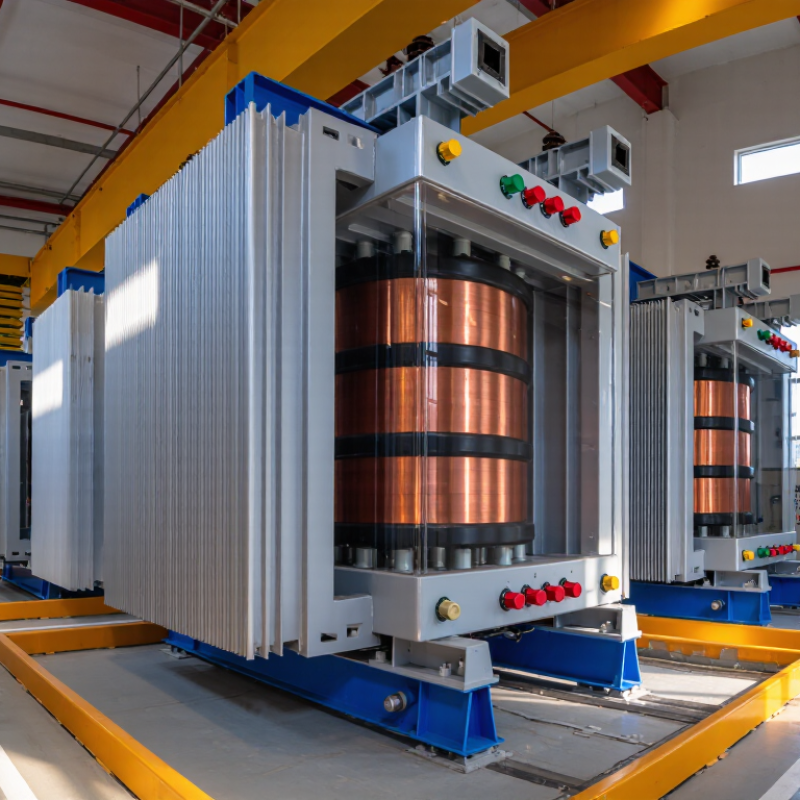
| Rated Power | Common dry type distribution ratings range from approximately 100 kVA to 2,500 kVA; larger ratings are available for specific projects. | Correct sizing prevents overheating, nuisance trips, excessive losses, and premature insulation aging. | Compare the continuous kVA rating with the calculated demand, motor starting current, harmonics, future expansion, and allowable overload profile. |
| Primary and Secondary Voltage | Specify the actual system voltage, frequency, tap range, vector group, and neutral arrangement. Medium-voltage dry transformers commonly serve systems from about 3.3 kV to 36 kV. | Voltage mismatch can create insulation stress, poor regulation, incorrect phase displacement, or inability to connect to the local grid. | Check the nameplate, approved drawings, routine test report, tap positions, phase sequence, and compatibility with IEC or IEEE requirements. |
| Efficiency and Losses | For modern distribution units, total efficiency around 98% or higher at practical loading is a reasonable screening benchmark; no-load and load losses must be evaluated separately. | Small improvements in losses can produce significant lifetime savings because transformers normally remain energized continuously. | Request guaranteed no-load loss, load loss at a stated reference temperature, impedance, test tolerance, and calculated efficiency at 25%, 50%, 75%, and 100% load. |
| Temperature Rise | An 80 K or 100 K winding temperature-rise design is commonly specified, depending on rating, insulation system, ambient temperature, and efficiency requirements. | Lower temperature rise generally improves thermal margin, overload capability, service life, and operating noise. | Confirm the specified ambient temperature, altitude, cooling method, temperature-rise class, hot-spot assumptions, and heat-run test results. |
| Insulation System | Class F insulation corresponds to a 155°C maximum insulation-system temperature, while Class H corresponds to 180°C; insulation class is not the same as permitted temperature rise. | The insulation system determines thermal endurance and resistance to aging under normal and abnormal operating conditions. | Review the insulation class, resin or varnish system, curing process, material certificates, and type-test evidence. |
| Partial Discharge | A project limit of ≤10 pC is frequently used for medium-voltage cast-resin transformers, subject to the specified test voltage and measurement method. | Low partial discharge indicates better internal insulation quality and reduces the risk of progressive electrical deterioration. | Require a partial-discharge test report stating test voltage, background noise, measuring equipment, calibration, acceptance limit, and winding identification. |
| Short-Circuit Impedance | Approximately 4%–6% is common for many distribution applications, although the correct value depends on fault level, voltage regulation, and parallel-operation requirements. | Impedance affects fault current, voltage drop, motor starting, load sharing, and protection coordination. | Verify measured impedance, tolerance, short-circuit withstand capability, relay settings, and compatibility with other transformers operating in parallel. |
| Sound Level | Approximately 55–68 dB(A) at 1 m is a practical preliminary range for many dry type distribution transformers; actual sound depends on rating, core design, enclosure, and operating voltage. | Noise affects offices, hospitals, residential buildings, data centers, and other noise-sensitive installations. | Request guaranteed sound power or sound pressure data, the measurement standard, test distance, background-noise correction, and enclosure condition. |
| Fire and Environmental Safety | Dry type transformers contain no mineral oil. Designs may be classified F1 for reduced flammability under IEC 60076-11, but they are not fireproof and still require appropriate fire protection. | Eliminating oil reduces spill and liquid-fire risks in buildings, tunnels, offshore facilities, and environmentally sensitive locations. | Check fire classification, smoke and toxicity requirements, enclosure ventilation, local fire code, and certified fire-performance documentation. |
| Enclosure and Ingress Protection | IP00 is generally used for protected indoor installations; IP23 or higher may be selected where protection from solid objects and water spray is required. | The enclosure must protect personnel and the windings without restricting cooling airflow. | Confirm the IP rating according to IEC 60529, ventilation path, access clearance, corrosion protection, cable-entry arrangement, and installation environment. |
| Altitude and Ambient Conditions | Standard assumptions commonly use an altitude up to 1,000 m and an ambient temperature defined by the applicable standard; higher altitude or hotter climates require derating or design modification. | Reduced air density decreases cooling performance and dielectric clearance, increasing thermal and insulation stress. | Provide site altitude, maximum and average ambient temperature, humidity, dust, salt exposure, seismic conditions, and indoor ventilation data. |
| Harmonic Load Capability | For rectifiers, UPS systems, variable-frequency drives, and data-center loads, specify harmonic current content and consider a K-factor or harmonic-duty design rather than using a standard unit automatically. | Harmonics increase eddy-current losses, winding heating, neutral current, vibration, and insulation stress. | Submit the load spectrum, THD values, neutral loading, loss calculation, temperature-rise evidence, and any required K-factor or derating statement. |
| Cooling and Thermal Monitoring | AN cooling is common. AN/AF forced-air cooling can increase available capacity, but the fan system requires controls, alarms, redundancy planning, and maintenance. | Effective cooling protects insulation life and supports controlled short-term overloads. | Check fan capacity, automatic start temperature, alarm and trip settings, sensor locations, auxiliary power, and failure-mode behavior. |
| Mechanical and Seismic Reliability | The transformer should withstand transport, lifting, electromagnetic short-circuit forces, vibration, and the project-defined seismic acceleration. | Mechanical damage can cause winding displacement, cracking, connection failure, or loss of dielectric clearance. | Review lifting points, transport restraints, anchoring details, short-circuit tests, seismic calculations, and installation torque requirements. |
| Standards and Testing | IEC 60076-11 is widely used for dry type transformers. IEEE C57.12.01 and applicable local standards may be required in other markets. | Recognized standards create a consistent basis for design, safety, testing, and acceptance. | Request routine-test reports and, where required, type or special-test reports covering ratio, polarity, winding resistance, losses, impedance, dielectric tests, temperature rise, and partial discharge. |
| Maintenance and Serviceability | No oil sampling or liquid leak management is required, but periodic cleaning, ventilation inspection, connection checks, thermal scanning, and protection testing remain necessary. | Low routine maintenance does not mean maintenance-free operation, especially in dusty or humid environments. | Obtain a maintenance schedule, recommended inspection intervals, spare-parts list, fan replacement procedure, warranty conditions, and service response terms. |
| Total Cost of Ownership | Evaluate purchase price together with no-load losses, load losses, installation, ventilation, maintenance, downtime risk, expected service life, and end-of-life disposal. | The lowest initial price may result in higher lifetime energy costs or greater operational risk. | Use the guaranteed loss schedule and local electricity tariff to calculate annual energy cost, payback period, and lifecycle cost over the planned operating period. |