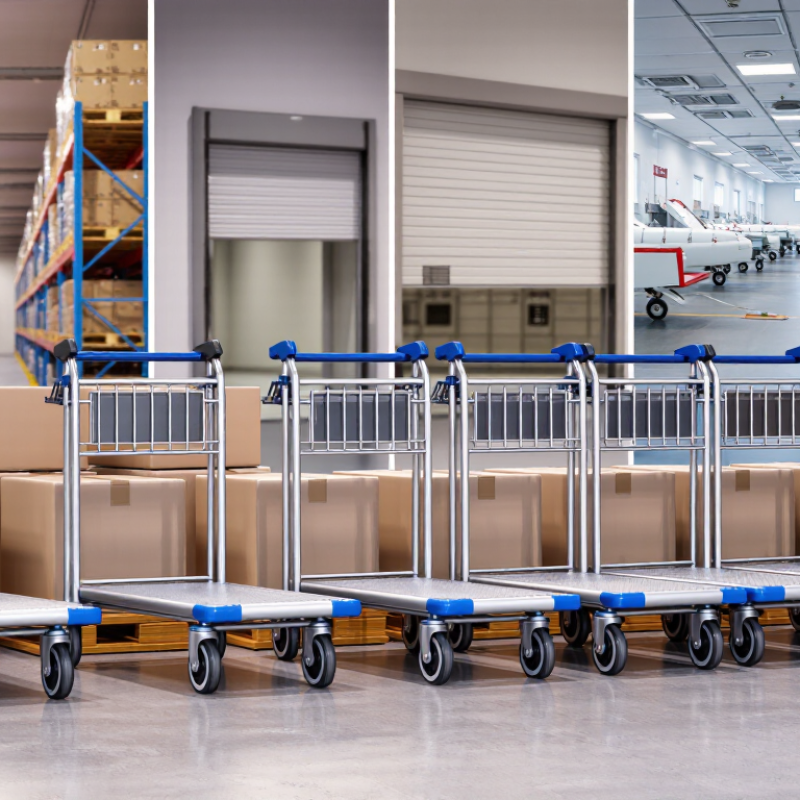
| Two-Wheel Sack and Container Trolley | 150–250 kg | 450–650 mm wide
1,000–1,400 mm high support frame | 2 pneumatic or solid wheels
Wheel diameter commonly 250–400 mm | Optional parking brake for level-floor use;
hand-operated brake recommended for ramps and dock plates | Use only when the load can be kept close to the frame.
Check handle height, grip clearance, centre of gravity, and visibility. | Apply the rated load evenly and verify frame stability, wheel security, handle deformation, and weld condition. Repeat with the load positioned toward the least stable operating direction. | ISO 11228-2: push/pull assessment
Verify that the actual starting and sustained forces are suitable for the intended users, floor condition, slope, and travel distance. |
| Two-Shelf Platform Trolley | 150–300 kg total | 600 × 900 mm to
750 × 1,200 mm | 4 swivel castors
Two fixed or directional castors are preferred for long corridors | Two braked swivel castors minimum for routine parking;
four-wheel braking preferred on sloped or uneven floors | Keep heavy items on the lowest shelf. Confirm that pushing forces, turning radius, and shelf height do not create excessive shoulder or wrist loading. | Test the total rated load distributed across both shelves. Check shelf deflection, castor attachment points, fasteners, corner guards, and resistance to forward, backward, and lateral movement. | EN 1757-3: platform-truck safety review
Inspect stability, running gear, handles, platforms, protective edges, and braking controls against the applicable edition and national adoption. |
| Three-Shelf Service and Picking Trolley | 200–400 kg total | 600 × 1,000 mm to
800 × 1,300 mm | 4 or 6 castors
Low-noise non-marking wheels for indoor logistics areas | At least two parking brakes on opposite sides;
directional lock may be specified for narrow aisles | Specify shelf lip height, load retention, handle position, and maximum shelf loading. Avoid placing dense loads above the trolley’s centre of mass. | Verify each shelf at its declared shelf capacity and the complete trolley at total rated capacity. Measure permanent deformation after unloading and inspect castor plates and shelf joints. | ISO 11228-2: force and task evaluation
Record initial movement force, continuous travel force, route gradient, floor joints, distance, frequency, and number of operators. |
| Heavy-Duty Warehouse Platform Trolley | 500–1,000 kg | 800 × 1,200 mm to
1,000 × 2,000 mm | 4 heavy-duty castors
Fixed-wheel and swivel-wheel combinations for directional stability | Positive parking brake on at least two wheels;
brake selection must match the maximum load and floor gradient | High loads can generate substantial starting and stopping forces. Consider powered assistance when route length, frequency, gradient, or load mass exceeds manual handling capability. | Use a documented proof-load procedure approved by the manufacturer or competent test body. Record load placement, holding time, wheel contact, structural deflection, brake holding, and post-test damage. | EN 1757-3: platform-truck design review
Confirm rated-load marking, safe operating instructions, stability, braking function, structural integrity, and suitability of the running gear. |
| Roll-Container and Cage Trolley | 400–800 kg | 650 × 800 mm to
800 × 1,200 mm base | 4 castors
Two swivel and two fixed castors are common for controlled tracking | Two or four wheel brakes depending on load, route, and parking frequency;
brake access must remain available when the cage is loaded | Assess doorways, ramps, dock transitions, aisle width, operator sightlines, and the risk of load shift through the mesh or side panels. | Test the base, mesh panels, doors, hinges, locking devices, castor mounts, and towing or coupling points where fitted. Perform a stability check with the load distributed high and low within the cage. | EN 1757-3: platform and running-gear review
Confirm that retaining structures, access points, handles, brakes, and rated-load information are appropriate for the intended application. |
| Low-Profile Pallet-Moving Trolley | 500–1,500 kg | Compatible with the pallet footprint;
commonly 800 × 1,200 mm or 1,000 × 1,200 mm | Heavy-duty fixed or swivel castors
Wheel and frame design must support concentrated pallet loads | Parking brake or wheel-locking system required where the trolley may be left unattended, parked on a gradient, or used during loading and unloading | Manual pushing may be unsuitable at high loads or over poor floors. Evaluate starting force, stopping distance, floor resistance, and route slope. | Apply the pallet load within the specified support zones. Check local deck deformation, castor capacity, frame twist, brake holding, and load retention during controlled starts and stops. | ISO 11228-2: push/pull risk assessment
Use measured force data rather than load mass alone when determining whether manual operation is appropriate. |
| Stainless-Steel Cleanroom or Food-Process Trolley | 100–300 kg total | 500 × 800 mm to
700 × 1,100 mm | 4 sealed non-marking castors
Corrosion-resistant wheel forks and fasteners | Two or four corrosion-resistant parking brakes;
brake components should remain cleanable and accessible | Select smooth, rounded surfaces and sealed bearings where hygiene is important. Confirm that cleaning chemicals and temperature exposure match the operating environment. | Verify rated load on every shelf, drainage or wash-down performance where relevant, castor attachment security, brake function, and absence of sharp edges or fluid traps. | EN 1757-3: applicable safety checks
Safety compliance does not by itself certify hygienic design; request separate material, cleanability, and chemical-resistance documentation. |