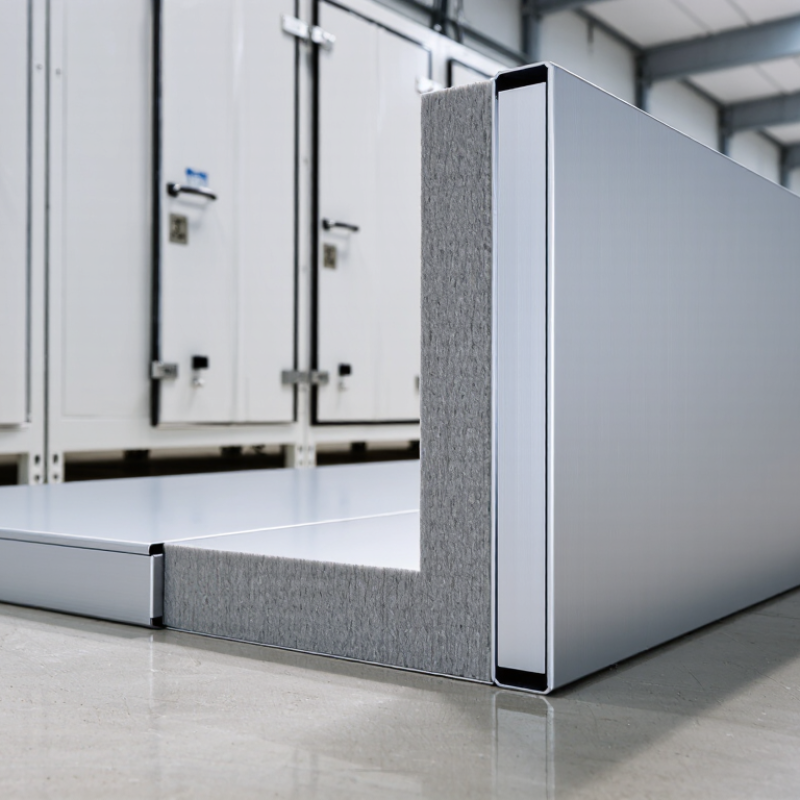
| Basic Definition | Insulated composite panel with two facings and a rigid polymer foam core | A foam sandwich panel combines structural or protective facings with a lightweight insulation core. “Non-aging” is a market term rather than a universal technical classification; performance should be verified through test reports and long-term design data. |
| Common Foam Core Types | PIR, PUR, phenolic foam, EPS, and XPS | PIR and PUR are widely used for building insulation. Phenolic foam can provide low thermal conductivity, while EPS and XPS have different moisture, fire, and mechanical-performance profiles. The suitable core depends on the application and local code. |
| Typical Core Density | Approximately 30–45 kg/m³ for many building panels | Density varies by foam chemistry, panel design, and required strength. Higher density may improve compressive or handling performance, but it can also increase weight and cost. |
| Typical Panel Thickness | Approximately 30–250 mm | Common thicknesses include 50, 75, 100, 120, and 150 mm. The correct thickness depends on climate zone, target U-value, indoor temperature, thermal bridges, and building energy requirements. |
| Thermal Conductivity | Approximately 0.020–0.040 W/(m·K), depending on core type and test condition | Lower thermal conductivity generally means better insulation at the same thickness. Buyers should compare declared or design values at the same reference temperature and use the applicable regional calculation method. |
| Thermal Resistance | Approx. 2.5–7.5 m²·K/W for 50–150 mm of core, before thermal bridges | Thermal resistance is approximately thickness divided by thermal conductivity. Actual whole-panel performance is affected by joints, fasteners, facings, edge details, and installation quality. |
| “Non-Aging” Performance | Should be demonstrated by long-term thermal-resistance or accelerated-aging data | Foam properties can change over time because of gas diffusion, temperature, moisture, installation conditions, and joint performance. Request aged design values rather than relying only on the initial laboratory value. |
| Water Absorption | Varies substantially by foam type, density, facing, and test method | Closed-cell foams generally resist liquid-water uptake better than open-cell materials, but panel edges, cut-outs, joints, and damaged facings can allow moisture entry. Check the exact standard and test result. |
| Fire Performance | Depends on core chemistry, facings, thickness, joints, and assembly design | Fire classification is not determined by the foam core alone. Ask for the complete panel assembly classification under the destination market’s required standard, including reaction-to-fire and, where relevant, fire-resistance testing. |
| Typical Facing Materials | Pre-painted steel, aluminum, stainless steel, or glass-fiber-reinforced facing | Metal facings provide protection, stiffness, and surface finish. Select coating type and thickness according to corrosion exposure, humidity, UV exposure, cleaning chemicals, and service temperature. |
| Common Facing Thickness | Approximately 0.30–1.00 mm for many metal-faced panels | Thicker facings may improve impact resistance, screw retention, appearance, and handling durability. The required value depends on span, support spacing, wind load, and project specifications. |
| Mechanical Strength | Varies by core density, facing thickness, panel profile, and span | Do not compare compressive strength alone. Review bending, shear, point-load, deflection, pull-out, and connection performance for the complete panel system and intended support spacing. |
| Typical Applications | Cold rooms, food-processing areas, warehouses, logistics buildings, roofs, walls, and modular structures | Applications differ in hygiene, temperature, vapor-control, fire, impact, and corrosion requirements. A panel suitable for a dry warehouse may not be suitable for a freezer room or a corrosive industrial environment. |
| Operating Temperature | Product-specific; often approximately −40°C to +80°C for selected systems | The allowable range depends on the foam, facings, adhesives, joints, and exposure duration. For refrigeration or high-temperature service, request documented limits for continuous and intermittent use. |
| Dimensional Stability | Must be verified under the intended temperature and humidity conditions | Long-term dimensional changes may result from thermal cycling, moisture, manufacturing tolerances, or incompatible installation details. Review flatness, joint movement, and temperature-cycle test data when stability is critical. |
| Joint and Vapor Control | Cam-lock, tongue-and-groove, overlap, or sealed joint systems | Panel-core performance can be undermined by poorly sealed joints or penetrations. Confirm gasket, sealant, vapor-barrier, fastener, and flashing details for the project’s humidity and temperature conditions. |
| Environmental Considerations | Assess blowing agents, recycled content, service life, and end-of-life options | Ask for environmental product information, refrigerant or blowing-agent data, and applicable life-cycle documentation. Environmental performance cannot be judged solely from the panel’s thickness or insulation value. |
| Quality-Control Documents | Test reports, technical datasheet, batch records, dimensional inspection, and coating certificates | For international purchasing, request documents covering thermal conductivity, density, dimensions, fire behavior, water absorption, mechanical properties, coating, tolerances, and production-batch traceability. |
| Relevant Standards | Examples include ISO, EN, ASTM, and local building-code methods | The correct standard depends on the destination country and application. Confirm whether the project requires EN 14509, ASTM-based testing, ISO methods, or another locally adopted specification before placing an order. |
| Selection Priority for 2026 Buyers | Verified aged performance + complete-system fire data | The strongest selection should balance aged thermal performance, fire classification, moisture control, structural capacity, corrosion resistance, installation details, documentation, and total delivered cost—not only the lowest purchase price. |