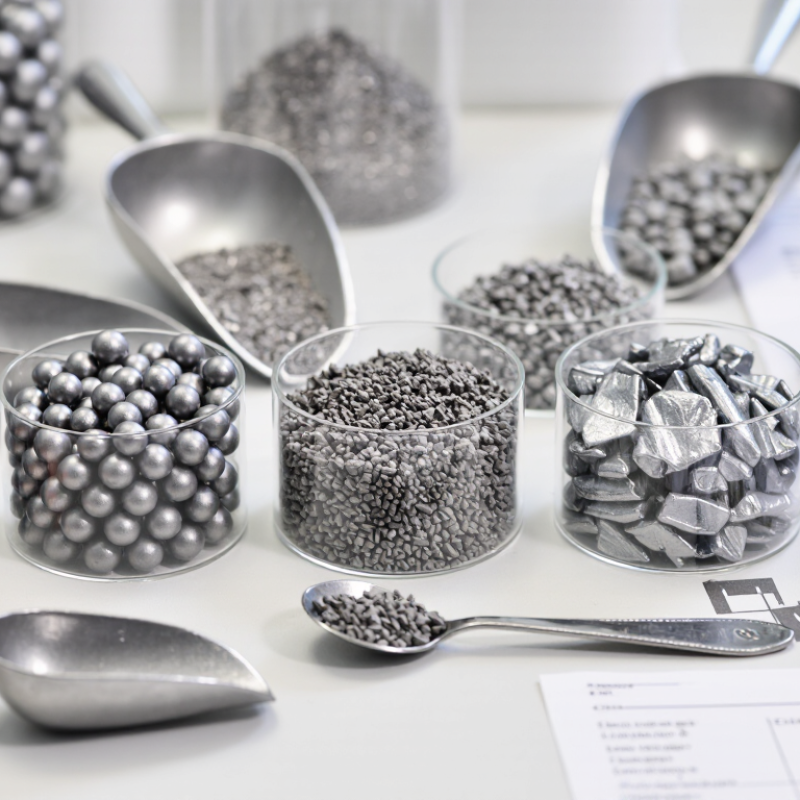
| Spherical atomized aluminum powder | Predominantly rounded particles, commonly produced by atomizing molten aluminum. Particle size distribution depends on the process and classification. | Considered where flow, packing consistency, and repeatable particle geometry are important. Confirm suitability for the intended process rather than relying on morphology alone. | Verify total aluminum content and impurity limits; particle size distribution; particle shape; apparent density; flow behavior; moisture; and lot-to-lot consistency. | ASTM B214 or ISO 4497 for sieve analysis; ISO 13320 for laser-diffraction particle-size analysis where appropriate; ASTM B212 for apparent density; ASTM B213 for flow rate. Use the method suited to the powder and agreed specification. | Fine aluminum powder can form combustible dust. Prevent dust release and ignition sources; use suitable dust controls, bonding/grounding, and protective equipment based on the site risk assessment and SDS. |
| Irregular or non-spherical atomized aluminum powder | Particles have less regular shapes than spherical grades. Shape and size can vary with atomization and subsequent processing. | May be selected when a buyer’s process accepts irregular particles or requires a particular packing, surface, or handling profile. Confirm performance through process-specific trials. | Check chemistry, particle-size distribution, morphology, apparent or tap density as relevant, moisture, and any process-specific acceptance criteria. | ASTM B214 and ISO 4497 are commonly used for sieve-based size analysis; ISO 3953 covers tap density of metal powders. These are test methods, not aluminum powder product-grade certifications. | Do not assume irregular powder is non-combustible. Avoid creating airborne dust; keep material away from incompatible substances and follow the product SDS and local combustible-dust requirements. |
| Flake aluminum powder | Thin, plate-like particles, generally made by mechanical milling and classification. Surface treatments or coatings may be present in some products; confirm whether the material is uncoated and meets the required chemistry. | Often chosen for applications that need a flake-shaped particle form. Its handling, dispersion, and performance differ from atomized spherical or irregular powders. | Confirm aluminum content, coating or treatment status, particle-size distribution, flake dimensions or morphology, volatile content where applicable, and batch consistency. | Agree a method suitable for flake geometry: sieve analysis alone may not describe lateral dimensions or thickness adequately. Request the supplier’s validated measurement method and test report. | Flake powders may create combustible dust and can be sensitive to handling conditions. Follow the SDS, avoid dust clouds and ignition sources, and use controls suitable for the specific product. |
| Coarse aluminum powder or granulated powder | Larger particles or granules produced by classification, compaction, or other processing. The term “coarse” has no single universal particle-size boundary. | Useful where a process specification calls for a coarser feed form or reduced fines. Ask for the actual size distribution and the definition of “coarse” used in the purchase specification. | Check the full size distribution, fines fraction, chemistry, moisture, bulk handling characteristics, and packaging integrity. | ASTM B214 or ISO 4497 may be used for sieve analysis when appropriate. Specify sieve series, sample preparation, and acceptance limits in the purchase contract. | Coarser material may still contain hazardous fines. Assess the supplied particle-size distribution and follow the SDS and applicable workplace rules. |
| High-purity aluminum powder | A chemistry-defined grade that may be supplied in spherical, irregular, or other morphologies. “High purity” does not identify a universal grade unless limits are stated. | Choose by the required aluminum assay and limits for individual impurities, together with the particle form and size needed for the application. | Request a lot-specific certificate of analysis with the analytical method, aluminum content, individual impurity results, particle-size data, and traceability information. | Specify the analytical method and impurity reporting limits in the contract. ASTM and ISO powder test methods generally describe measurement procedures; they do not establish one universal purity grade for all aluminum powders. | High chemical purity does not remove the fire, dust, or reactivity hazards of finely divided aluminum. Apply the same product-specific SDS controls. |
| Buyer-defined controlled-size grade | Any morphology supplied to a jointly agreed particle-size distribution and chemistry specification. Grade names and size ranges vary among suppliers and applications. | Best defined through explicit limits rather than labels such as “fine,” “standard,” or “premium.” State target distribution, allowable oversize and fines, morphology, and intended use. | Require agreed sampling, test methods, acceptance limits, retest rules, batch identification, and documentation. Compare test results only when methods and sample preparation are comparable. | Potential methods include ASTM B214 or ISO 4497 for sieve analysis, ISO 13320 for laser diffraction, ASTM B212 for apparent density, and ASTM B213 for flow rate. Select methods appropriate to the powder and contract. | Packaging, storage, transport classification, and workplace controls must be based on the specific product, its SDS, and destination-country regulations. |