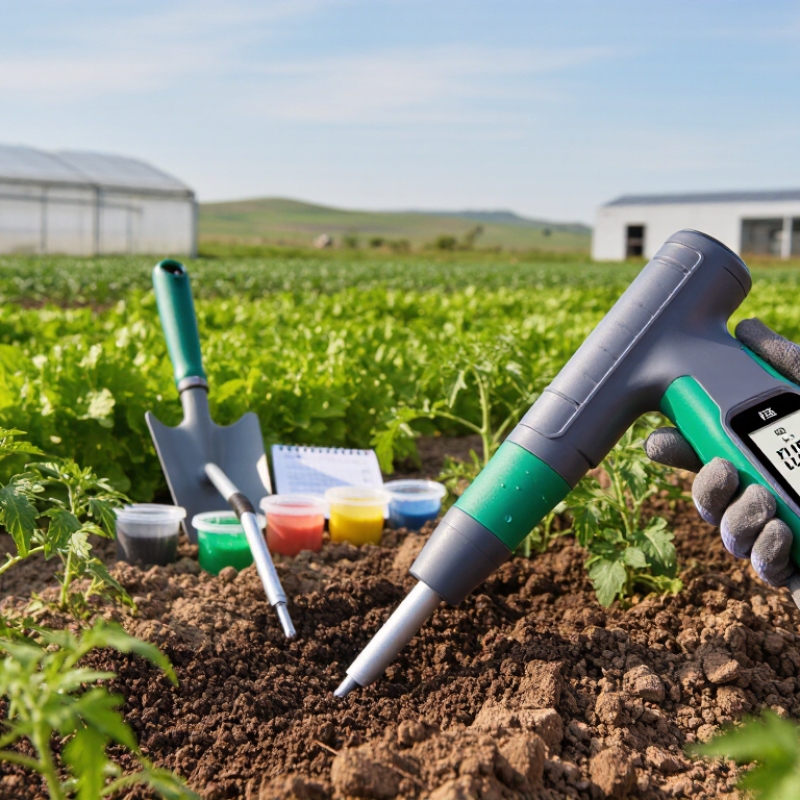
| Single-Parameter pH Tester | Routine soil acidity checks for gardens, nurseries, and field crops | Glass or solid-state electrode after calibration | Soil pH | pH 0.00–14.00; most soils commonly fall between pH 4 and 9 | Approximately ±0.05 to ±0.10 pH | Usually requires a soil-water or calcium chloride slurry; direct-probe models vary | Calibration stability, replaceable electrode, temperature compensation |
| 3-in-1 Soil Meter | Home gardening and quick screening where laboratory precision is not required | Electrical or analog sensing probes | Moisture, pH, light | Moisture: relative scale; pH: commonly 3–8; light: relative scale | Screening-level results; performance varies significantly by soil type | Generally no slurry for basic readings; clean and insert probe consistently | Simple operation, repeatability, probe corrosion resistance |
| Digital NPK Soil Tester | Comparative nutrient screening for fertilizer planning | Ion-selective, electrochemical, or extraction-based measurement depending on model | Nitrogen, phosphorus, potassium; some models also measure pH and moisture | Typically displayed as low, medium, high, or approximate mg/kg bands | Model-dependent; field screening is generally less precise than laboratory extraction | Often requires a soil-water extract or reagent solution for more reliable results | Defined calibration procedure, nutrient-specific validation, consumable availability |
| Portable EC and Salinity Meter | Greenhouses, irrigation management, and salt-affected soils | Electrical conductivity measurement with temperature compensation | Electrical conductivity, salinity, temperature | Commonly 0–20 mS/cm; higher-range models are available | Approximately ±1% to ±2% of full scale for many professional handheld units | Usually uses a soil-water extract or measured drainage solution | Cell constant accuracy, automatic temperature compensation, calibration standards |
| Soil Moisture Probe | Irrigation scheduling and water-use monitoring | Capacitance, frequency-domain, or resistance-based sensing | Volumetric water content or relative soil moisture | Relative dry-to-wet scale or approximately 0–100% VWC, depending on calibration | Often approximately ±2% to ±5% VWC after soil-specific calibration | Requires firm soil contact; calibration is affected by texture, density, and salinity | Probe length, installation method, data logging, and soil-specific calibration |
| Professional Multi-Parameter Field Meter | Commercial farms, agronomy services, and repeatable field surveys | Interchangeable electrodes and validated extraction or sensor methods | pH, EC, temperature, moisture; optional nutrient or oxidation-reduction readings | pH 0–14; EC commonly 0–20 mS/cm; temperature typically −5–60°C | Typically better repeatability than consumer meters when correctly calibrated | Often requires standardized extraction, filtering, and cleaning procedures | Data export, rugged housing, serviceability, calibration records, replacement probes |
| Laboratory Soil Test Kit | Buyers requiring documented nutrient results for agronomic decisions | Chemical extraction followed by colorimetric comparison or photometric reading | Usually pH, nitrate or nitrogen, available phosphorus, and potassium | Depends on the extraction method and reagent scale; commonly reported in mg/kg or rating bands | Method-dependent and generally more defensible than uncalibrated direct-probe readings | Requires representative sampling, mixing, extraction, reagents, and timed reactions | Method documentation, reagent shelf life, reference charts, and quality control |