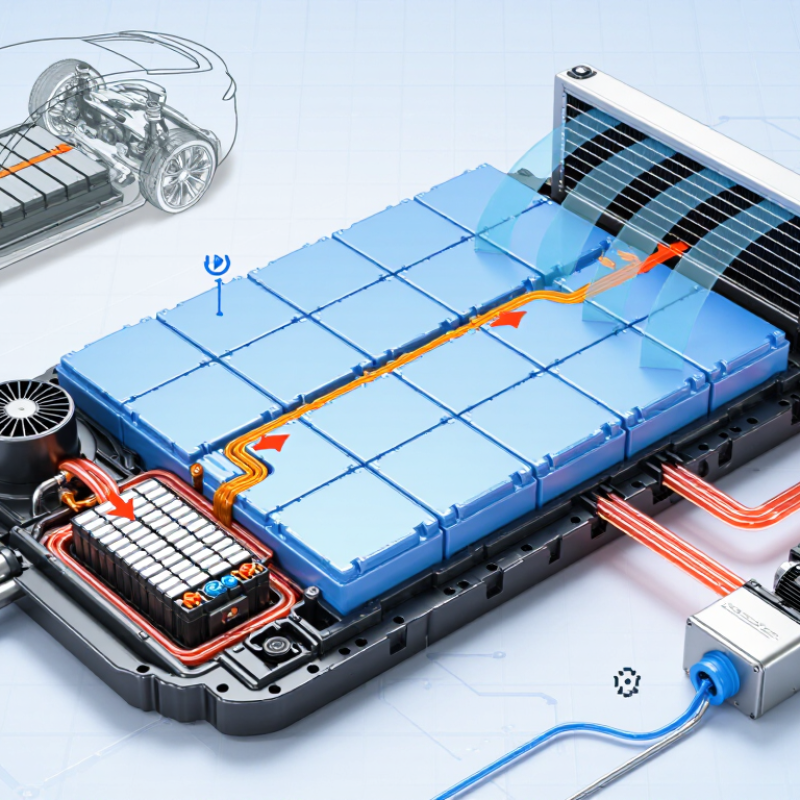
| Battery cooler | A thermal-management system for removing or adding heat | It transfers heat between battery cells and a cooling or heating medium, helping keep cell temperatures within the limits selected for the battery chemistry and operating conditions. |
| Cell-to-cell temperature spread | ΔT = hottest measured cell temperature − coolest measured cell temperature; around 5°C is a common design objective in many systems | Limiting the spread can reduce uneven aging and performance among cells. A 5°C objective is not a universal regulatory limit; the acceptable value depends on the pack design, chemistry, test conditions, and manufacturer requirements. |
| Typical operating-temperature planning | Many lithium-ion applications manage cells within an approximate 15–35°C operating region, subject to chemistry and system specifications | This is a broad engineering reference, not a universal charging or operating limit. The battery maker’s specified temperature limits take precedence, especially during fast charging and cold-weather operation. |
| Air cooling | Fans move ambient or conditioned air through ducts and around cells | Air carries heat away by convection. The system is relatively simple, but airflow distribution and air temperature can affect how evenly cells are cooled. |
| Liquid cooling | A pump circulates coolant through channels, often in cold plates near the cells | Heat passes from cells into the plate and then into the flowing coolant. Flow distribution, plate contact, coolant temperature, and channel layout influence temperature uniformity. |
| Refrigerant-based cooling | A refrigeration circuit removes heat through an evaporator or a connected coolant loop | The system can provide active cooling when ambient air or a basic coolant loop is not sufficient. Controls must manage temperature and avoid local overcooling or condensation risks. |
| Immersion cooling | Cells or modules contact a dielectric liquid that does not conduct electricity like water-based coolant | The liquid absorbs heat directly from exposed surfaces and can help distribute heat. Fluid compatibility, sealing, serviceability, and system design are important considerations. |
| Sensors and control | Temperature sensors report readings to the battery-management or thermal-control system | The controller can adjust pumps, fans, valves, heaters, or refrigeration based on temperature readings and operating state. Sensor location and measurement accuracy affect the estimated cell-to-cell spread. |
| Heating in cold conditions | A heater or heat-pump-based system may warm the battery when needed | Heating can bring cells into a suitable temperature range before or during operation. Charging limits at low temperatures remain chemistry- and specification-dependent. |
| What affects temperature uniformity? | Cell spacing, heat generation, contact resistance, coolant or airflow distribution, and pack geometry | Designers assess these factors under different loads and ambient conditions. A single average pack temperature may not reveal local hot or cold spots. |