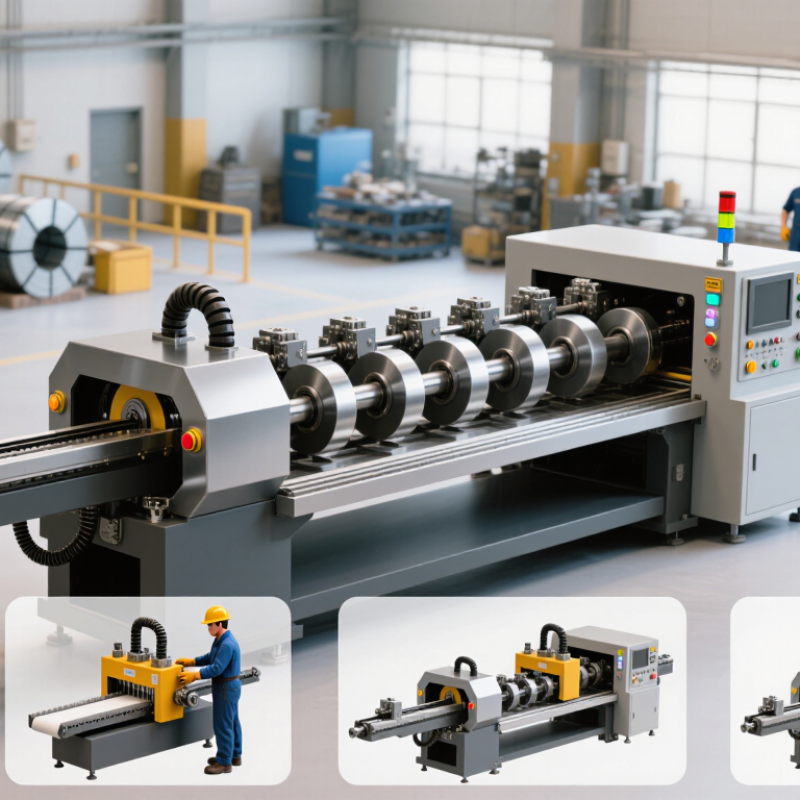
| Standard U Panel Roll Forming Machine | Continuous cold roll forming with fixed forming stations and automatic cutting | Pre-painted steel, galvanized steel, and aluminum | Approximately 0.30–1.20 mm | Approximately 600–1,250 mm, depending on the profile | Approximately 8–20 m/min | Roofing panels, wall cladding, partition panels, and general building envelopes | Stable production, simple operation, moderate investment, and consistent profile geometry | A fixed roll set normally supports one main profile and a limited thickness range | Small and medium manufacturers with a defined U-panel specification |
| Interchangeable Cassette U Panel Machine | Roll forming with removable or interchangeable cassette tooling | Galvanized steel, coated steel, and aluminum alloys | Approximately 0.35–1.50 mm | Approximately 600–1,250 mm per configured profile | Approximately 8–18 m/min | Manufacturers producing several U-panel sizes or related panel profiles | Faster profile changeover and greater product flexibility than a dedicated line | Higher tooling cost and more setup requirements; changeover time depends on the cassette design | Factories serving multiple construction projects or regional specifications |
| High-Speed Servo U Panel Line | Continuous roll forming with servo-driven feeding, synchronized cutting, and electronic control | Pre-painted steel and galvanized steel, subject to material strength | Approximately 0.30–0.80 mm | Approximately 600–1,000 mm per profile | Approximately 15–30 m/min, depending on cut length and profile complexity | High-volume production of lightweight roofing and wall U panels | Higher throughput, accurate length control, reduced manual adjustment, and better repeatability | Higher purchase and maintenance requirements; speed may decrease with thicker or stronger steel | Large-volume producers with stable orders and standardized products |
| U Panel Roll Forming Line with Automatic Stacking | Roll forming, hydraulic or servo cutting, conveying, and automatic panel stacking | Galvanized steel, coated steel, and aluminum, according to tooling design | Approximately 0.30–1.20 mm | Approximately 600–1,250 mm | Approximately 8–20 m/min | Production lines that require reduced handling and organized finished-panel packaging | Lower labor demand, improved material handling, and more consistent finished-product bundles | Requires more floor space, integration, and investment than a basic roll forming machine | Medium and large plants focused on production efficiency and logistics |
| Hydraulic Press U Panel Forming Machine | Batch forming with a matched die set and hydraulic pressing force | Carbon steel, galvanized steel, stainless steel, and thicker sheet materials | Approximately 1.50–4.00 mm, subject to press capacity and die design | Approximately 400–1,200 mm per component | Approximately 2–8 strokes/min | Heavy-duty U-shaped structural parts, channels, brackets, and short-run components | Handles thicker materials and complex bends that may not be suitable for continuous roll forming | Lower output, higher die cost, and greater manual handling compared with continuous lines | Users requiring heavy-gauge U sections, deep bends, or low-to-medium production volumes |
| CNC Adjustable U Panel Forming Machine | Computer-controlled bending with adjustable tooling or programmable forming axes | Mild steel, galvanized steel, stainless steel, and aluminum | Approximately 0.50–3.00 mm, depending on machine tonnage | Approximately 300–3,000 mm working length | Approximately 3–12 bends/min, depending on the number of operations | Custom U panels, varied dimensions, prototypes, and short production runs | High dimensional flexibility, quick program changes, and suitability for customized parts | Lower continuous output and greater dependence on operator programming and setup accuracy | Job shops and manufacturers with frequent changes in panel size or design |