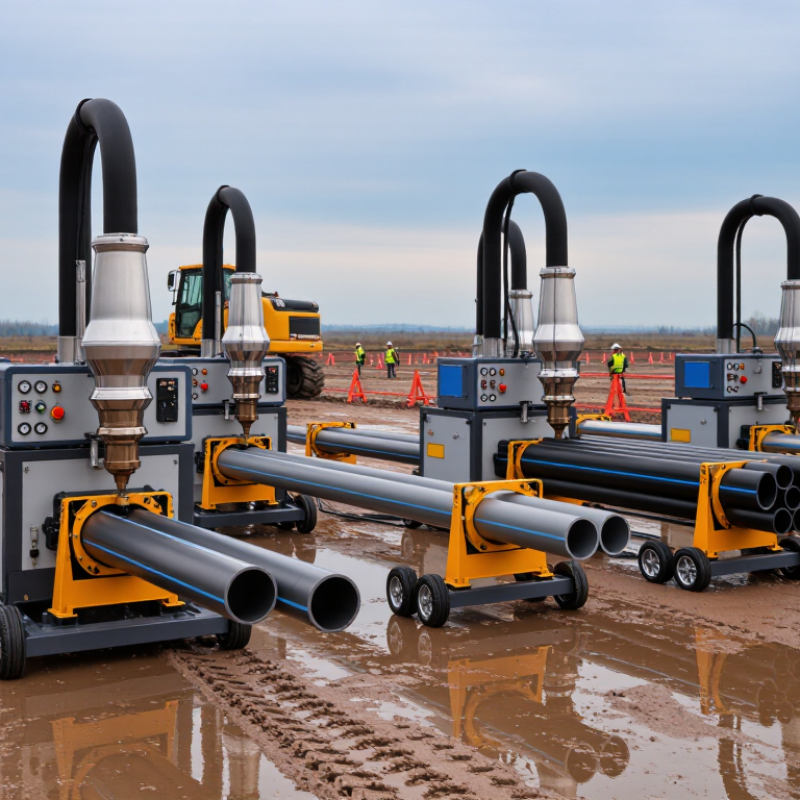
| 1 | Hydraulic Butt-Fusion Machine for Large-Diameter Pipe | Butt fusion
Hydraulic clamping, facing and controlled joining | 315–1,600 mm
Typical use: 500 mm and above | PE100, PE80, PP and compatible thermoplastics | Usually 180–260°C, selected according to the material and approved procedure | Municipal water mains, gas distribution, industrial pipelines, mining slurry and water-treatment lines | High joining force, strong alignment and repeatable results on thick-wall pipe | Check hydraulic pressure control, clamping range, machine footprint, lifting requirements and compliance with ISO 21307, ASTM F2620 or DVS 2207-1 |
| 2 | Manual or Hydraulic Butt-Fusion Welder for Medium-Diameter Pipe | Butt fusion
Manual or hydraulic operation | 63–630 mm | PE, PP and selected thermoplastic pressure pipe | Typically 180–250°C, depending on resin and procedure | Water supply, irrigation, compressed-air systems, wastewater and utility construction | Versatile size range with a good balance between portability and joining force | Confirm actual pipe outside-diameter range, SDR compatibility, heater uniformity and availability of interchangeable inserts |
| 3 | Compact Manual Butt-Fusion Welder for Small Pipe | Butt fusion
Manual clamps and hand-operated pressure | 20–160 mm | PE, PP, PB and other weldable thermoplastics | Commonly 180–250°C, controlled by a thermostatic heater | Building services, small irrigation networks, plumbing repairs and low-volume fabrication | Low transport weight, simple setup and economical operation | Look for a stable frame, accurate temperature control, non-stick heater coating and clear pressure or force guidance |
| 4 | Electrofusion Control Unit for Utility Pipework | Electrofusion
Electrical current heats resistance wires inside a fitting | 20–1,000 mm, depending on fitting system | Primarily PE80 and PE100; compatible electrofusion fittings must be used | Controlled by the fitting's barcode, data plate or manufacturer-approved parameters | Gas and water service connections, repair saddles, tie-ins and restricted-access installations | No pipe-end facing machine is required; suitable for confined areas and complex repairs | Verify output voltage and current, barcode or manual input functions, data recording, generator compatibility and ISO 12176-2 conformity |
| 5 | Electrofusion Processor with Traceability Functions | Electrofusion
Automated fusion cycle with data logging | 20–630 mm, subject to fitting manufacturer limits | PE pressure pipe systems and approved electrofusion fittings | Automatically set from fitting data; normally no manual heater temperature setting is required | Gas networks, drinking-water infrastructure and projects requiring documented joint records | Stores fusion parameters, operator information, error codes and job records for quality assurance | Check barcode standards, memory capacity, export format, calibration service, ingress protection and operating-temperature range |
| 6 | Socket-Fusion Welder for Small-Diameter Thermoplastic Pipe | Socket fusion
Heated male and female tools create a bonded socket joint | 16–125 mm, with tooling determined by the pipe system | PP-R, PP, PE and other socket-fusion-compatible materials | Often 200–270°C, depending on material and applicable standard | Hot- and cold-water plumbing, building services, process piping and small irrigation systems | Fast installation, compact tooling and practical use in workshops or service vehicles | Check tool-size accuracy, heating-surface coating, temperature stability, electrical plug standard and compliance with ISO 15874 or the relevant pipe standard |
| 7 | CNC or Automatic Butt-Fusion Machine for Fabrication Shops | Automated butt fusion
Programmable hydraulic cycle and digital monitoring | 90–630 mm, with larger configurations available | PE, PP, PVDF and other approved thermoplastics | Typically 180–260°C, set for the specific material and qualified procedure | Prefabricated manifolds, industrial pipe spools, skid systems and repeat production | Consistent heating, pressure and dwell times with reduced operator variation | Evaluate control accuracy, stored welding recipes, calibration records, hydraulic maintenance and operator training requirements |
| 8 | Low-Pressure or Gravity-Drainage Butt-Fusion Welder | Butt fusion
Light-duty clamping and heating system | 110–500 mm | PE and selected polypropylene drainage pipe | Usually 180–240°C, subject to the pipe manufacturer's procedure | Stormwater drainage, sewer rehabilitation, landfill drainage and non-pressure conduits | Lower equipment cost and easier transportation than heavy pressure-pipe machines | Confirm whether the machine supports the pipe wall thickness, ovality correction and alignment requirements of the drainage system |
| 9 | PVDF and High-Temperature Thermoplastic Fusion Welder | Butt or socket fusion
High-accuracy heater and controlled joining cycle | 20–315 mm | PVDF, PP-H, ECTFE and other chemically resistant thermoplastics approved for fusion | Approximately 220–300°C, depending on the material and qualified joining procedure | Chemical processing, semiconductor utilities, pharmaceutical systems and laboratory water treatment | Suitable for demanding corrosion-resistant piping where contamination control is important | Check temperature uniformity, material compatibility, clean-room or low-contamination requirements and documented welding procedures |
| 10 | Battery-Powered or Portable Electrofusion Welder | Electrofusion
Portable power supply for field joining | 20–315 mm, depending on output capacity and fitting system | PE and compatible electrofusion fittings | Controlled by fitting parameters rather than a manually selected heater temperature | Emergency repairs, remote pipelines, service connections and locations without reliable mains electricity | Easy transportation, rapid deployment and reduced dependence on generators | Assess battery runtime, charging time, maximum fusion energy, weather protection, spare batteries and compatibility with local fitting standards |