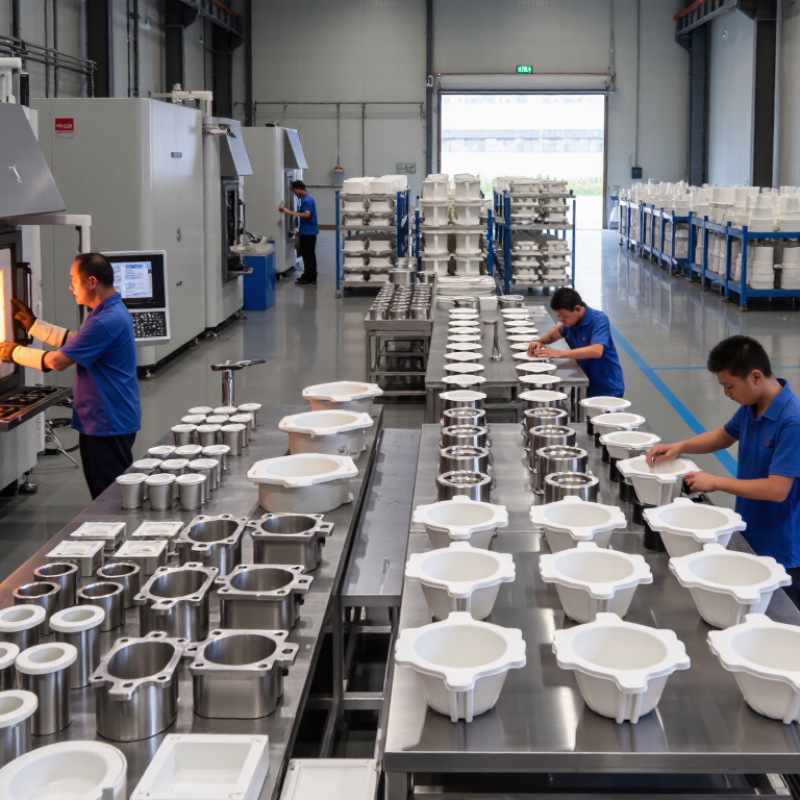
| Process Definition | Dewaxing casting, commonly called investment casting or lost-wax casting, uses a disposable wax pattern to create a ceramic mold. The wax is removed before molten metal is poured. | It enables complex metal parts to be produced with fewer joints, reduced machining, and accurate replication of intricate geometries. |
| Typical Production Sequence | Die preparation, wax injection, pattern assembly, ceramic slurry coating, stuccoing, drying, dewaxing, mold firing, metal pouring, shell removal, cutoff, finishing, inspection, and packing. | A clearly controlled sequence helps buyers evaluate process capability, production consistency, lead time, and quality-control checkpoints. |
| Common Ferrous Alloys | Carbon steel, low-alloy steel, stainless steel, heat-resistant steel, and tool steel are commonly suitable for investment casting, subject to the foundry’s equipment and process controls. | Material selection affects corrosion resistance, strength, heat performance, weldability, service life, and compliance with the end-use specification. |
| Common Non-Ferrous Alloys | Aluminum, copper-based alloys, cobalt-based alloys, and selected nickel-based alloys can be produced through investment casting when the required melting and pouring controls are available. | The process can support lightweight designs, electrical conductivity, wear resistance, high-temperature performance, and specialized engineering requirements. |
| Part Size Range | Investment casting is generally used for small to medium-sized components. Practical size and weight limits vary significantly according to alloy, geometry, shell system, furnace capacity, and handling equipment. | Global buyers should confirm maximum dimensions and casting weight using an engineering drawing rather than relying on a universal process limit. |
| Geometric Capability | The process is well suited to thin sections, internal passages, undercuts, curved surfaces, fine details, and near-net-shape components that may be difficult to machine. | Complex geometry can reduce assembly steps, material waste, secondary machining, and total part count. |
| Dimensional Accuracy | Investment castings commonly achieve tighter dimensional control than many conventional sand-casting methods. Actual tolerances depend on part size, alloy, geometry, wax tooling, shell process, and inspection method. | Buyers should define critical dimensions, allowable deviations, datum references, and inspection methods in the technical drawing or purchase specification. |
| Surface Finish | The ceramic shell can produce a relatively smooth as-cast surface compared with ordinary sand casting. Surface roughness depends on slurry formulation, stucco size, shell layers, alloy, and finishing operations. | A smoother surface may reduce grinding, polishing, machining allowance, and the risk of stress-concentrating surface defects. |
| Tooling Requirement | Reusable wax dies are normally required for repeated production. Tooling may be produced from aluminum, steel, or other suitable materials, depending on volume, design complexity, and budget. | Tooling cost and approval time should be considered together with expected annual volume and the required product life cycle. |
| Prototype Options | For prototypes or low-volume parts, wax patterns may be produced using additive manufacturing or other tooling-reduction methods, depending on the required accuracy and surface quality. | Buyers can validate form, fit, function, and manufacturability before committing to production tooling. |
| Secondary Operations | Typical operations include cutoff, grinding, shot blasting, heat treatment, CNC machining, passivation, electropolishing, plating, coating, and non-destructive testing. | A supplier capable of coordinating finishing and inspection can simplify sourcing, reduce logistics steps, and improve traceability. |
| Quality Inspection | Depending on the application, inspection may include chemical analysis, dimensional measurement, visual inspection, hardness testing, tensile testing, radiographic testing, dye penetrant testing, magnetic particle testing, and metallographic examination. | Inspection evidence helps confirm alloy identity, dimensional conformity, internal integrity, and suitability for regulated or safety-critical applications. |
| Relevant Standards | Specifications may reference ASTM, ISO, EN, DIN, JIS, or customer-defined requirements. The applicable standard depends on the alloy, industry, inspection scope, and destination market. | Clear standards reduce ambiguity in material composition, mechanical properties, tolerances, testing, documentation, and acceptance criteria. |
| Typical Applications | Common applications include valves, pumps, impellers, fittings, medical instruments, aerospace components, automotive parts, food-processing equipment, industrial hardware, and energy-related components. | The broad application range makes investment casting suitable for both engineered components and customized replacement parts. |
| Economic Advantages | The process can reduce machining allowance, consolidate multiple components, minimize material waste, and support repeatable production of complex shapes. | The lowest purchase price is not the only cost factor; buyers should compare tooling, machining, finishing, inspection, packaging, freight, and rejection risk. |
| Key Supplier Evaluation Factors | Important factors include alloy capability, wax and shell technology, furnace capacity, process documentation, inspection equipment, traceability, production capacity, export experience, and engineering communication. | A structured evaluation helps global buyers select a manufacturing partner that can meet technical, commercial, delivery, and compliance requirements. |