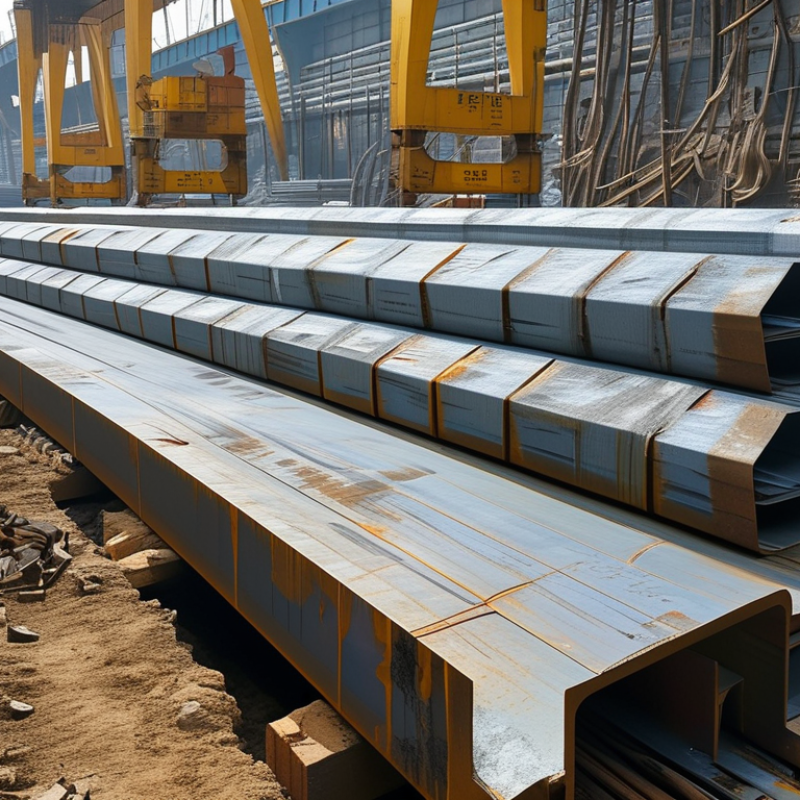
| 1 | Product definition | Interlocking hot rolled steel sections | Steel sheet piles are rolled sections driven into the ground or seabed to form a continuous retaining or cutoff wall. | Retaining walls, cofferdams, quay walls, flood barriers, and excavation support | Wall performance depends on section geometry, steel grade, embedment depth, soil conditions, and bracing. |
| 2 | U-shaped sheet piles | U-profile with the interlocks positioned near the neutral axis | A traditional profile family that provides good bending resistance and flexible wall assembly. | Temporary excavation walls, riverbank protection, cofferdams, and small marine structures | Often suitable for reuse, but the effective section properties may be influenced by interlock slip and connection condition. |
| 3 | Z-shaped sheet piles | Z-profile with the interlocks located near the outer edges | A high-efficiency profile that places more steel away from the neutral axis to increase section modulus. | Deep permanent walls, port structures, bridge abutments, and major earth-retaining works | Generally offers efficient steel usage for higher bending demands; driving conditions and interlock strength must be checked. |
| 4 | Straight-web sheet piles | Flat or straight-web sections with strong interlocks | Sections designed primarily to resist hoop tension and form cellular structures rather than act as ordinary cantilever beams. | Circular cells, cellular cofferdams, bulk storage structures, and large temporary enclosures | Connection strength and cell geometry are critical; they are not normally selected solely on conventional bending capacity. |
| 5 | Combined wall systems | Primary tubular or H-shaped king piles with sheet pile intermediates | A composite wall arrangement used to achieve higher stiffness, bending resistance, or wall depth than individual sheet piles can provide. | Deep quay walls, heavy marine walls, bridge approaches, and large excavation projects | Requires accurate fabrication, alignment, connection detailing, lifting planning, and specialized driving equipment. |
| 6 | Typical steel grades | Structural grades commonly specified by national or international standards | Steel grades define yield strength, tensile strength, elongation, weldability, and inspection requirements. | General civil engineering, marine construction, infrastructure, and temporary works | The selected grade should match the design code, required toughness, welding procedure, temperature exposure, and corrosion allowance. |
| 7 | Standard length range | Commonly supplied in approximately 6–24 m lengths; project-specific lengths may be available | Length determines the achievable embedment, unsupported height, handling method, and number of field splices. | Temporary works, permanent retaining walls, waterfront construction, and flood-control projects | Transport restrictions, crane capacity, driving rig height, ground obstructions, and splice design must be considered. |
| 8 | Manufacturing process | Hot rolling, straightening, cutting, inspection, and bundling | Hot rolling forms the complete cross-section and integral interlocks in a continuous mill process. | Projects requiring repeatable geometry, high production volume, and reliable interlock engagement | Quality checks typically include dimensions, straightness, surface condition, mechanical properties, and interlock compatibility. |
| 9 | Installation methods | Vibratory driving, impact driving, pressing, and pre-drilling where appropriate | Installation transfers the piles into the ground while maintaining alignment and interlock engagement. | Urban excavations, marine sites, hard ground, soft soils, and vibration-sensitive locations | Equipment selection depends on soil resistance, pile size, access, noise limits, nearby structures, and allowable vibration. |
| 10 | Applications and service life | Temporary or permanent use; bare, coated, or corrosion-protected steel | Sheet piles provide earth retention, water cutoff, hydraulic protection, and structural support. | Basements, underground stations, ports, seawalls, flood defenses, river training, and contaminated-site barriers | Service life is governed by corrosion environment, water chemistry, tidal exposure, coating system, sacrificial thickness, and maintenance. |