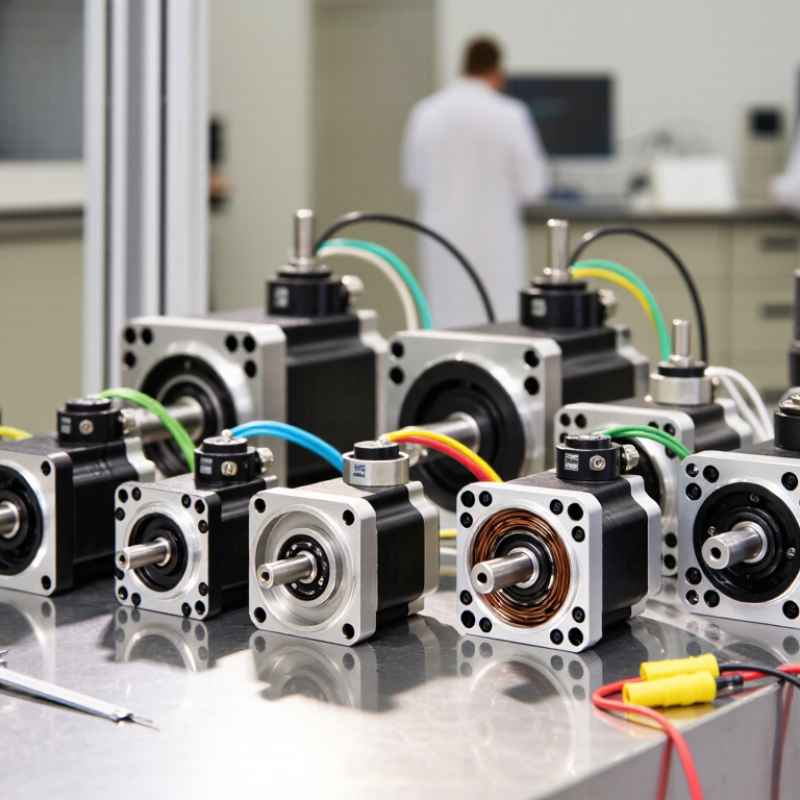
Profile 01
Standard precision | Two-phase hybrid stepper motor with a toothed permanent-magnet rotor and laminated stator | Sequential energization of the two stator phases creates a rotating magnetic field that aligns the rotor teeth to discrete magnetic positions. | 1.8° full step; 0.9° available with finer tooth geometry | 0.05–12 N·m | Radiation-tolerant magnet wire, inorganic or polyimide insulation, ceramic or metal bearing retainers, and low-outgassing materials | 104–106 Gy, project-dependent | −40°C to +125°C | Vacuum positioning stages, laboratory instruments, and shielded motion assemblies | Verify torque derating, insulation resistance, and step-loss margin after irradiation. |
Profile 02
High resolution | Five-phase hybrid stepper motor with multiple stator phase groups | Five independently controlled phase windings divide the electrical rotation into smaller positional increments and reduce torque ripple. | 0.72° or 0.36° full step | 0.1–8 N·m | Rad-hard winding insulation, mechanically restrained coil heads, radiation-stable adhesives, and shielded feedback wiring | 105–106 Gy, qualification required | −55°C to +125°C | Optical mechanisms, detector positioning, and precision sample handling | Use a compatible five-phase driver; confirm phase resistance drift over temperature and dose. |
Profile 03
Compact actuator | Permanent-magnet can-stack motor with a simple toothed stator and enclosed rotor | Alternating current pulses magnetize the stator poles, causing the permanent-magnet rotor to move from one stable detent position to the next. | 7.5°–15° | 0.005–0.25 N·m | Glass-filled or ceramic structural parts, radiation-compatible wire insulation, and minimized organic content | 104–105 Gy, application-specific | −40°C to +100°C | Valves, shutters, latches, and low-load instruments | Prioritize low mass and low power, while checking detent torque and thermal dissipation in vacuum. |
Profile 04
High torque | Two-phase hybrid motor with a larger rotor diameter and extended magnetic circuit | Phase currents establish discrete electromagnetic poles; the increased air-gap area produces higher torque at low speed. | 1.8° | 8–40 N·m | Radiation-resistant insulation systems, nonmagnetic fasteners, high-retention rotor magnets, and reinforced winding supports | 105–106 Gy, subject to magnet and insulation testing | −40°C to +120°C | Heavy positioning stages, antenna mechanisms, and industrial radiation zones | Check available driver voltage, acceleration torque, thermal path, and structural vibration limits. |
Profile 05
Vacuum compatible | Low-outgassing hybrid stepper motor with sealed or dry-lubricated bearing arrangement | Controlled phase currents produce incremental rotor alignment while the mechanical package limits contamination and lubricant evaporation. | 1.8° or 0.9° | 0.1–10 N·m | All-metal or ceramic-compatible materials, dry-film lubricants, low-outgassing insulation, and screened cable assemblies | 104–106 Gy, depending on materials and shielding | −20°C to +100°C | High vacuum, space-simulation chambers, and semiconductor process equipment | Evaluate outgassing, bearing life, heat rejection, and torque performance at the specified pressure. |
Profile 06
Feedback-ready | Hybrid stepper motor integrated with a radiation-tolerant resolver or position sensor interface | Open-loop step commands are supplemented by position feedback, allowing the control system to detect missed steps and compensate for load changes. | 1.8°; closed-loop interpolation may provide finer commanded resolution | 0.2–15 N·m | Radiation-qualified sensor materials, shielded signal paths, redundant insulation, and separated power and feedback routing | 104–106 Gy; sensor dose may be the limiting factor | −40°C to +125°C | Mission-critical actuators, robotic mechanisms, and long-duration monitoring systems | Qualify the complete motor-sensor-driver chain rather than the motor alone. |
Profile 07
Low power | Small-frame two-phase hybrid motor optimized for reduced phase current | Short, controlled current pulses move the rotor between stable magnetic states while minimizing electrical consumption and heat generation. | 1.8° or 3.6° | 0.01–1 N·m | High-temperature wire enamel, radiation-stable bobbin materials, compact metal housing, and reduced organic bonding agents | 104–105 Gy, depending on construction | −40°C to +85°C | Portable instruments, sensor adjusters, and battery-powered mechanisms | Compare holding current, standby heating, minimum starting torque, and driver efficiency. |
Profile 08
High temperature | High-temperature hybrid stepper motor using thermally stable insulation and bearing materials | Phase-controlled stator excitation produces incremental rotation while the motor is designed to maintain insulation and magnetic performance at elevated temperature. | 1.8° | 0.1–10 N·m | Polyimide or equivalent high-temperature insulation, ceramic bearings where appropriate, high-temperature magnets, and inorganic varnish systems | 104–106 Gy, depending on temperature-dose combination | −55°C to +200°C | Reactor instrumentation, accelerator equipment, and high-temperature test systems | Assess combined radiation, temperature, vacuum, and duty-cycle effects; these factors are not independent. |
Profile 09
Hollow-shaft | Hollow-shaft hybrid motor allowing cables, optical fibers, or drive components to pass through the rotor axis | Electromagnetic phase sequencing rotates the toothed rotor while the central opening supports compact coaxial system integration. | 1.8° or 0.9° | 0.2–8 N·m | Radiation-compatible shaft insulation, restrained internal wiring, metal or ceramic coupling elements, and low-outgassing bearings | 104–106 Gy, project-dependent | −40°C to +125°C | Rotary optical filters, cable-routing mechanisms, and compact inspection systems | Check shaft torsional stiffness, through-bore clearance, runout, and heat transfer through the mounting flange. |
Profile 10
Shielded assembly | Radiation-resistant stepper motor installed inside a localized shielding and thermal-management enclosure | The motor operates through standard phase-controlled electromagnetic stepping, while shielding reduces the accumulated dose received by sensitive materials. | 1.8°; microstepping depends on the driver and load | 0.1–20 N·m | Tungsten, tantalum, lead-free heavy-metal, or steel shielding selected by radiation type; qualified insulation and feedthroughs | 105–107 Gy at component level, depending on shielding design | −40°C to +150°C | High-dose laboratories, accelerator beamlines, and nuclear inspection equipment | Design shielding for gamma, neutron, or mixed fields separately; verify weight, heat buildup, and secondary radiation. |