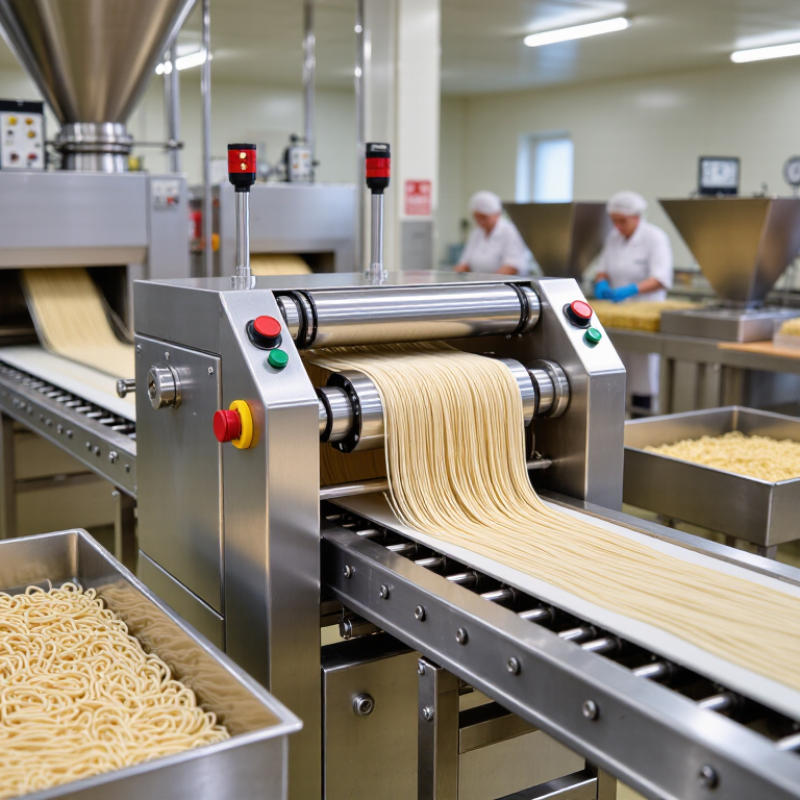
| Product category | Codex CXS 249-2006, Standard for Instant Noodles | The product must be an instant noodle product manufactured from wheat flour and/or other permitted flours or starches, water, and optional ingredients. | Select a complete line with flour dosing, mixing, resting, sheeting, slitting, steaming, cutting, portioning, and either frying or hot-air drying. | Review the process flow, ingredient list, product specification, and factory trial samples before purchase. |
| Finished-product moisture | Codex CXS 249-2006 | Maximum moisture is generally 10.0% for fried instant noodles and 14.0% for non-fried instant noodles under the Codex standard. | Choose a fryer or hot-air dryer with multi-zone temperature control, adjustable residence time, and automatic moisture feedback capability. | Test representative samples using a validated moisture method at the end of the production line and during shelf-life trials. |
| Frying-oil quality | Codex CXS 249-2006; local edible-oil and food-safety rules may also apply | For fried instant noodles, the Codex specification includes an acid value limit of 2.0 mg KOH/g oil and a peroxide value limit of 10 meq active oxygen/kg oil. | Use continuous oil filtration, oil-level control, temperature uniformity control, oil sampling points, and a system for removing crumbs and degraded oil. | Measure acid value and peroxide value according to recognized laboratory methods; define alarm and oil-change limits in the HACCP plan. |
| Process choice: fried or non-fried | Codex CXS 249-2006; destination-market labeling rules | Fried noodles require control of oil quality and fat uptake. Non-fried noodles require validated hot-air or other drying conditions to achieve the applicable moisture limit. | Choose a fryer for rapid dehydration and typical fried texture, or a multi-zone dryer with controlled airflow, humidity, and residence time for non-fried products. | Compare moisture, texture, cooking time, fat content, energy use, and sensory results using pilot batches. |
| Target capacity | Production planning requirement; local licensing documents may require declared capacity | Illustrative design basis: 80 g finished noodle block at 6,000 packs per hour equals approximately 480 kg of finished product per hour, before line losses. | Select a nominal line capacity at least 10–20% above the required saleable output to cover start-up losses, cleaning, changeovers, and normal downtime. | Confirm sustained output over an eight-hour trial, including reject rate, stoppage time, energy consumption, and actual pack weight. |
| Dough mixing and hydration | Codex CXS 249-2006; Codex CXC 1-1969, General Principles of Food Hygiene | The dough must be sufficiently mixed and hydrated to produce uniform sheeting, strand strength, and cooking performance. | Use stainless-steel mixers with programmable mixing time, controlled water dosing, ingredient traceability, and easy cleaning access. | Check dough temperature, hydration consistency, sheet integrity, strand breakage, and batch-to-batch variation. |
| Sheet thickness and noodle geometry | Product specification established by the manufacturer; labeling and identity must remain truthful in the destination market | Illustrative specification: sheet thickness 0.8–1.2 mm, strand width 1.0–1.5 mm, and portion weight controlled within the declared net quantity tolerance. | Choose adjustable roll gaps, interchangeable slitter blades, automatic strand alignment, and servo-controlled cutting and portioning. | Measure thickness and width with calibrated gauges; verify cooking time, strand appearance, and pack-weight capability. |
| Steaming and gelatinization | Codex CXS 249-2006; process controls under Codex CXC 1-1969 | The noodle structure must be adequately cooked or gelatinized before dehydration so that the finished product rehydrates consistently. | Use a continuous steam tunnel with controlled steam pressure, conveyor speed, condensate drainage, and independent temperature monitoring. | Validate starch gelatinization, rehydration time, firmness, and internal temperature across the full conveyor width. |
| Food-contact materials and hygienic design | Codex CXC 1-1969; applicable national food-contact-material requirements | Food-contact surfaces must be cleanable, corrosion-resistant, non-toxic, and protected against contamination. | Specify stainless-steel food-contact parts, sanitary welds, sloped surfaces, removable guards, minimal dead zones, and tool-free access where practical. | Review material certificates, hygienic-design drawings, cleanability tests, lubrication controls, and pre-operational sanitation records. |
| Allergen and cross-contact control | Codex CXS 1-1985, General Standard for the Labelling of Pre-packaged Foods; destination-market allergen laws | Wheat is a cereal containing gluten and must be managed as an allergen where required. Other allergens may enter through seasonings or shared equipment. | Choose segregated ingredient dosing, enclosed powder transfer, validated dry-cleaning access, and changeover procedures for seasoning and oil systems. | Verify allergen mapping, cleaning validation, label review, swab or analytical testing where justified, and documented changeover release. |
| Contaminants and food additives | Codex CXS 193-1995, General Standard for Contaminants and Toxins in Food and Feed; Codex CXS 192-1995, General Standard for Food Additives; local limits may be stricter | Ingredients, processing aids, additives, and contaminants must comply with the destination country’s permitted-use and maximum-level requirements. | Use accurate micro-dosing equipment, calibrated weighing systems, ingredient identification controls, and stainless-steel conveying equipment that prevents foreign-material entry. | Maintain supplier certificates, batch records, calibration records, additive calculations, and laboratory test results for relevant hazards. |
| Packaging and net quantity | Codex CXS 1-1985; Codex CXS 346-2021 where applicable to date marking; local weights-and-measures and packaging rules | The package must protect the noodles from moisture and contamination, and the declared net quantity, ingredient list, allergen information, lot identification, and date marking must be accurate. | Select a packaging system with checkweighing, seal-temperature control, metal detection or equivalent foreign-body control, batch coding, and compatible film handling. | Perform seal-strength, leak, packaging-integrity, net-weight, code-legibility, and accelerated shelf-life tests. |
| Local regulatory adaptation | Examples include Regulation (EC) No 852/2004 in the European Union, 21 CFR Part 117 in the United States, and applicable national food standards in other markets | Codex provides an international baseline, but the importing or selling jurisdiction controls registration, hygiene, additives, contaminants, labeling, worker safety, and environmental requirements. | Purchase a line with configurable recipes, multilingual HMI records, exportable production data, safety guarding, emergency stops, and documentation suitable for regulatory inspection. | Create a market-specific compliance matrix and obtain approval from the relevant food, machinery, electrical, and workplace-safety authorities before commissioning. |
| Validation before purchase | Codex HACCP principles under CXC 1-1969; customer specification and local regulatory requirements | The selected line must consistently produce safe, compliant noodles at the declared weight, moisture level, cooking performance, and shelf-life target. | Require factory acceptance testing and site acceptance testing covering capacity, moisture, oil quality, sanitation, safety interlocks, changeover time, and reject handling. | Approve the machine only after documented test results meet the agreed specification under normal operating conditions. |