How to Choose the Best Aluminium Melting Furnace?
Choosing the best aluminium melting furnace requires more than comparing purchase prices. The furnace must match alloy families, batch sizes, charging methods, and production schedules. A small foundry may value flexible batch control, while a high-volume plant may need continuous melting and automatic tapping. These differences affect metal quality, energy use, labor, and maintenance.
Industry data makes the decision more urgent. The International Energy Agency reports that aluminium production consumes about 4% of global electricity. The International Aluminium Institute states that recycled aluminium requires roughly 5% of the energy used for primary aluminium production. These figures highlight the value of efficient remelting, accurate temperature control, and low metal loss. However, efficiency depends on operating conditions. Poor scrap preparation can increase oxidation, dross, and furnace time, even with advanced equipment.
Small details matter.
This guide examines fuel type, furnace capacity, thermal efficiency, refractory design, emissions control, and automation. It also considers crucible, reverberatory, rotary, and induction systems. Each aluminium melting furnace has practical strengths and limitations. Induction systems can offer precise control, but their electrical demand and metal cleanliness requirements deserve careful review. Gas-fired furnaces may provide useful capacity and flexibility, yet combustion performance and heat recovery must be evaluated. Manufacturer claims should be checked against measured fuel consumption, melt yield, temperature stability, and service records. No furnace is perfect. The best choice is the one that fits the real process, not the most impressive brochure. A careful buyer should also review regional safety standards, operator training, spare-parts availability, and total cost over the furnace’s working life.
Aluminium Melting Basics: 660.3°C Melting Point and Alloy Requirements
How to Choose the Best Aluminium Melting Furnace?
Aluminium melts at 660.3°C, but furnace selection should not stop at this number. In practical workshop trials, operators often need controlled temperatures between 680°C and 760°C. The correct range depends on alloy composition, casting speed, and required fluidity. Excessive heat can increase oxidation, hydrogen absorption, and metal loss. Insufficient heat may cause poor filling and visible casting defects. That margin matters.
Different alloys require different thermal treatment. Some casting alloys need careful holding temperatures to protect magnesium or other reactive elements. A furnace should provide stable heating, accurate temperature measurement, and enough capacity for your batch size. Consider fuel efficiency, crucible compatibility, exhaust control, and ease of cleaning. A furnace that melts quickly may still perform poorly if its temperature fluctuates during holding. This is where selection becomes less obvious.
Tips: Measure the metal, not only the furnace chamber. Use a calibrated thermocouple and record melting times for each alloy. Keep the crucible clean and remove oxide carefully. Avoid unnecessary superheating, even when production is behind schedule. Review your results after every batch. Some assumptions will be wrong. A modest furnace with steady control can outperform a larger unit operated without discipline. Always confirm alloy data through technical standards or qualified metallurgical advice before changing process temperatures.
Aluminium Melting Basics: 660.3°C Melting Point and Alloy Requirements
Aluminium alloys melt across different temperature ranges. Pure aluminium melts at 660.3°C, while alloying elements can lower the solidus temperature and widen the melting range. Furnace selection should therefore consider the alloy, batch size, heating uniformity, temperature control and required superheat.
How to read the chart: The solidus temperature is where melting begins, while the liquidus temperature is where the alloy becomes fully liquid. The values shown are approximate and can vary with alloy composition and material specification.
Furnace Types Explained: Fuel, Electric, Induction, and Holding Systems
How to Choose the Best Aluminium Melting Furnace?
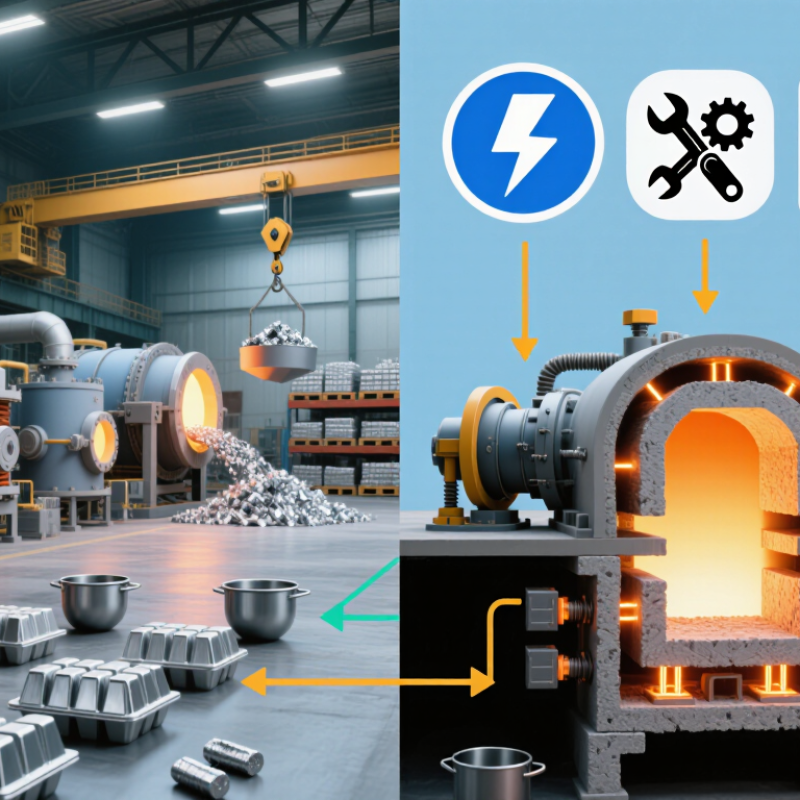
Fuel, electric, induction, and holding furnaces suit different production realities. Gas-fired furnaces remain practical for large batches and heavy crucibles. Their flame heats the chamber directly, but exhaust losses can be significant.
The U.S. Department of Energy reports that recuperative burners may reduce fuel consumption by up to 30% in suitable process-heating applications. That figure depends on maintenance, operating temperature, and furnace design. It should not become a sales promise.
Electric resistance furnaces offer clean, controllable heating and simple temperature programming. They are useful where electricity is stable and emissions at the workshop matter. Induction furnaces heat the metal itself, often achieving fast melting and strong temperature uniformity. They require higher electrical infrastructure and careful coil maintenance.
Holding systems are different. They preserve molten aluminium between batches, reducing repeated melting cycles and oxidation. The International Aluminium Institute states that recycled aluminium requires about 5% of the energy used for primary aluminium production. Efficient holding can help protect that advantage, although electricity still has an environmental cost.
My first instinct was to choose induction. That was too simple.
A furnace should be judged by batch size, alloy change frequency, melt-loss records, energy tariffs, ventilation, and operator experience.
A small foundry may gain more from a well-insulated electric furnace than an oversized induction unit.
Measure the real cycle. Forecasts alone can mislead.