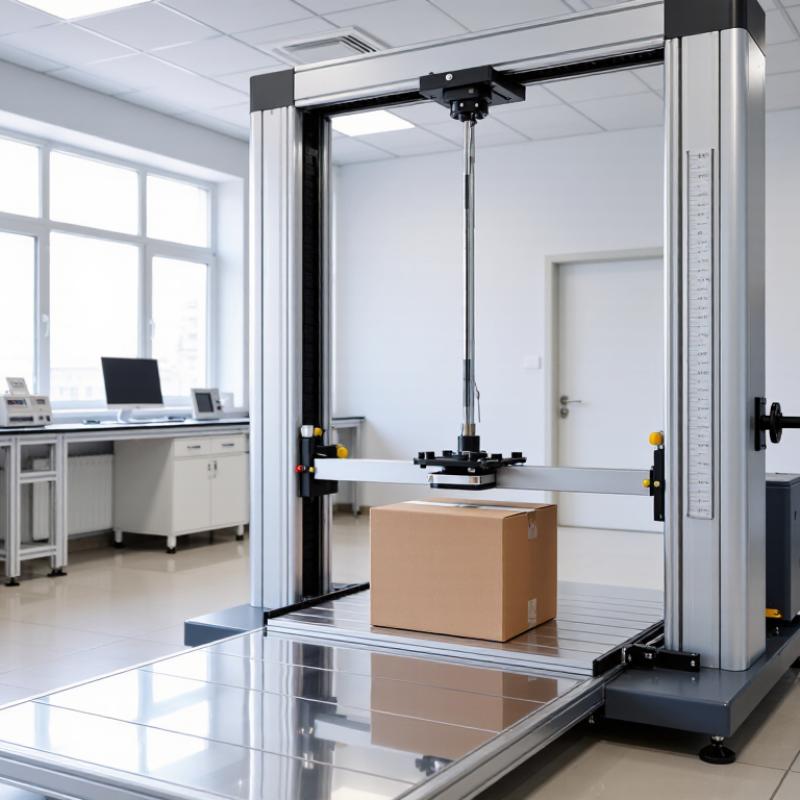
Free-Fall
Evaluate general shipping durability | The packaged product is released from a specified height and allowed to fall freely onto a rigid, level impact surface. The package may be tested in several predetermined orientations. | Vertical free-fall drop tester with an adjustable release height, rigid impact table, secure specimen release mechanism, and sufficient clearance for the package to rotate or deform safely. | - Package mass and dimensions
- Specified drop height
- Drop orientation and sequence
- Loaded condition, including product, cushioning, and accessories
- Impact surface rigidity and flatness
| ASTM D5276, Standard Test Method for Drop Test of Loaded Containers by Free Fall; ISO 2248, Packaging — Complete, filled transport packages — Vertical impact test by dropping. | Product function, package rupture, seal failure, cushioning damage, panel deformation, loose components, and any change that could affect transport protection. | Choose this configuration when the test plan specifies a true free fall and multiple package orientations. The release device should not guide the package after release or add significant contact before impact. |
Face Impact
Test a broad panel surface | One defined package face, such as the top, bottom, front, rear, or side panel, strikes the impact surface first. | Free-fall tester with orientation control, or a face-drop fixture that supports accurate positioning without restricting the intended impact. | - Identify the six package faces
- Mark the intended face before testing
- Keep the package center of gravity and release position consistent
- Record package dimensions and mass
- Use a rigid, level impact surface
| ASTM D5276 and ISO 2248 can be used when the procedure requires a face-first drop. The exact height and number of drops must be taken from the selected protocol or customer specification. | Crushed panels, product-to-package contact, broken internal supports, loss of compression strength, leakage, and visible damage to the tested face. | Select this option when the package faces have different structural functions or when the bottom and top panels require separate verification. |
Edge Impact
Stress a package edge | A designated package edge is positioned to contact the impact surface first. The edge is normally defined by the intersection of two package faces. | Free-fall tester with an edge-positioning fixture or adjustable edge support that can be removed or cleared immediately before release. | - Define the target edge by face names or coordinates
- Control the release angle and height
- Account for package center of gravity
- Use edge markings and high-speed video if orientation is difficult to verify
- Ensure the fixture does not cushion the impact
| ASTM D5276 may be applied when edge drops are included in the test sequence. ISTA procedures may also define specific edge orientations and sequences for particular distribution environments. | Corner-post buckling, seam opening, edge crush, frame distortion, internal cushioning displacement, and damage transmitted toward the product. | Choose an edge-control fixture when repeatable edge-first contact is more important than unrestricted random rotation after release. |
Corner Impact
Challenge concentrated load paths | A designated package corner makes first contact with the impact surface. This produces a concentrated impact and can load several package panels simultaneously. | Corner-drop positioning fixture with adjustable supports, a repeatable release system, and a rigid impact table. The fixture should be removed from the impact path before contact. | - Identify the corner using three intersecting faces
- Control corner orientation and release height
- Check the center of gravity for asymmetric packages
- Record the corner sequence and condition after every drop
- Use a sacrificial or reinforced fixture if the package could damage the support
| ASTM D5276 and applicable ISTA procedures may include corner drops. The chosen standard or project specification determines the exact height, sequence, and acceptance criteria. | Corner crushing, vertical product movement, internal block failure, puncture, closure opening, product breakage, and loss of package stability. | Select this setup for concentrated-load evaluation, especially for rectangular cases with vulnerable corners, vertical supports, or molded cushioning features. |
Repeated Drops
Assess cumulative damage | The same package is dropped multiple times according to a defined orientation sequence to represent repeated handling impacts. | Programmable or manually sequenced free-fall tester with a drop counter, height scale, orientation documentation, and rapid reset capability. | - Number of drops
- Drop sequence and orientation
- Time between drops
- Package condition before each drop
- Functional inspection intervals
| ASTM D5276 and distribution simulation procedures may specify repeated drops. Use the complete procedure rather than selecting a height or sequence independently. | Progressive crushing, fatigue of closures, loosening of internal components, cumulative product damage, and changes in package stiffness. | Choose a tester with reliable height repeatability and a clear method for documenting orientation and package condition throughout the sequence. |
Impact Energy
Compare severity between test setups | Estimate the gravitational potential energy converted during a drop. For an idealized free fall, the impact energy is calculated as E = mgh. | Drop tester with accurate mass and height records. Optional accelerometers or force sensors can provide additional impact data, but they do not replace the specified drop method. | - m = package mass in kilograms
- g = approximately 9.81 m/s²
- h = drop height in meters
- Example: a 10 kg package dropped from 1.0 m has approximately 98.1 J of gravitational potential energy
- Ideal impact velocity: v = √(2gh); at 1.0 m, approximately 4.43 m/s
| Use the calculation as an engineering comparison only. ASTM and ISO package drop methods define test conditions and acceptance requirements that may not be based solely on calculated energy. | Impact severity, acceleration pulse, force transmission, cushioning response, package deformation, and product shock response. | Select instrumentation when the objective includes shock characterization or cushioning comparison. For pass/fail package qualification, first prioritize compliance with the required drop standard. |
Large or Heavy Package
Handle difficult specimens safely | Test a package whose mass, dimensions, or center of gravity makes manual positioning unsafe or makes a standard small-package tester unsuitable. | High-capacity drop tester with a load-rated impact table, large working area, guarded operating zone, mechanical or powered lifting, and a release system designed for the specimen size. | - Maximum package mass and dimensions
- Maximum diagonal and corner clearance
- Required drop-height range
- Table size and structural capacity
- Operator guarding and emergency stop provisions
| ASTM D5276, ISO 2248, or the applicable customer and distribution test procedure, provided that the selected equipment meets the specimen capacity and safety requirements. | Structural package damage, product function, fixture stability, operator safety, and repeatability of release and impact orientation. | Choose equipment based on the complete loaded package, not the empty container. Include product, cushioning, pallet or accessories when they are part of the test specimen. |