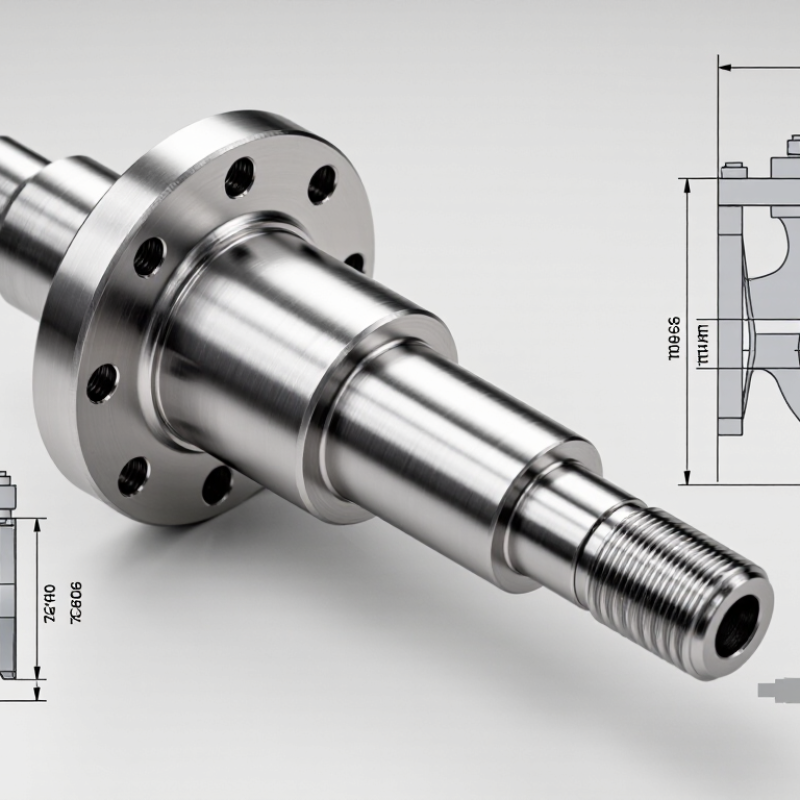
| Dimensions | Stem diameter | Common machined stem diameters: approximately 6–50 mm, depending on valve size, design, pressure class, and actuator load. | Measure the bearing, packing, threaded, and sealing sections separately with a calibrated outside micrometer. Do not rely only on the nominal valve size. | Use the valve assembly drawing and the specified dimensional tolerances. For general dimensional tolerancing, the drawing may reference ISO 2768 where applicable. |
| Dimensions | Stem length | Must match the original design from the thrust shoulder or drive interface to the end of the stem; even a small length error can affect travel and actuator engagement. | Compare the overall length, shoulder locations, thread run-out, and end profile against the approved drawing or a verified sample. | Valve-specific drawings and manufacturer tolerances control this dimension. API, ASME, and ISO valve standards generally do not replace the product drawing for stem geometry. |
| Dimensions | Thread and drive interface | Confirm thread diameter, pitch, thread form, handedness, keyway, square, flats, or splined connection before ordering. | Use thread gauges, pitch gauges, calipers, and a profile template. Check full engagement with the matching nut or actuator component. | Thread details should be stated on the component drawing. ISO metric thread dimensions may be referenced to ISO 724 and ISO 965 when metric threads are specified. |
| Dimensions | Surface finish and sealing zones | The packing and seal-contact surfaces should be free of scoring, laps, burrs, corrosion pits, and sharp edges. | Inspect visually under adequate lighting and measure roughness where required by the drawing or seal supplier. Check concentricity of critical sealing diameters. | Surface-finish limits are normally defined on the engineering drawing. A rough or damaged sealing surface can cause leakage even when the nominal diameter is correct. |
| Material | 304 / 304L stainless steel | General-purpose austenitic stainless steel with good corrosion resistance; typically non-magnetic in the annealed condition. | Confirm the exact grade and heat number through the material test report. Verify chemistry by positive material identification when required. | ASTM A276 covers stainless steel bars and shapes; ASTM A479 covers stainless steel bars and shapes for pressure-vessel and general applications. The purchase specification must identify the required grade. |
| Material | 316 / 316L stainless steel | Higher resistance to chloride-containing environments than 304 grades because of molybdenum content; 316L has lower carbon content. | Review the chemical composition, especially chromium, nickel, molybdenum, and carbon values, against the specified material grade. | ASTM A276 and ASTM A479 are commonly used material specifications. Material selection must still account for temperature, chloride concentration, crevice conditions, and stress-corrosion risk. |
| Material | 410 / 420 martensitic stainless steel | Heat-treatable grades offering higher hardness and wear resistance than austenitic grades, with generally lower corrosion resistance. | Check heat-treatment condition, hardness, and dimensional stability after machining. Confirm that the hardness is compatible with packing and mating components. | ASTM A276 includes stainless steel bars and shapes. The required hardness and heat-treatment condition should be stated on the purchase order or drawing. |
| Material | 17-4 PH stainless steel | Precipitation-hardening stainless steel providing high strength and good dimensional stability when correctly aged. | Verify the specified condition, such as H900, H1025, or another approved aging condition, together with hardness and tensile-property results. | ASTM A564 covers hot-rolled and cold-finished age-hardening stainless steel bars and shapes. The heat-treatment condition must be explicitly specified. |
| Standards | Pressure and design compatibility | The stem material and geometry must support the valve’s pressure class, temperature range, operating torque, and corrosion environment. | Match the stem specification to the valve pressure-temperature rating, actuator torque, packing system, and design calculation. | ASME B16.34 addresses pressure-temperature ratings, materials, dimensions, and testing requirements for many valve types. It does not by itself define every stem dimension. |
| Standards | Valve-specific construction | Gate, globe, check, ball, and butterfly valves may use different stem retention, anti-blowout, sealing, and drive arrangements. | Confirm the valve type, nominal size, pressure class, end connection, stem design, and revision level before selecting a replacement. | API 600 is used for many bolted-bonnet steel gate valves; API 608 covers metal ball valves; API 609 covers butterfly valves. Select the standard appropriate to the valve type. |
| Standards | Pressure testing | The completed valve assembly should pass the specified shell and seat tests; a stem-only component cannot demonstrate complete valve tightness. | Request the valve pressure-test record when purchasing a complete valve. For a replacement stem, verify dimensional fit, material, and functional testing after assembly. | ISO 5208 specifies pressure testing of metallic valves. API 598 is also widely used for inspection and testing of certain industrial valves. |
| Supplier Quality | Material traceability | Each stem should be traceable to a heat or lot number linked to the raw-material certificate and production records. | Check physical marking, packaging identification, lot records, and consistency between the stem, certificate, and purchase order. | Request an EN 10204 inspection document, preferably a Type 3.1 certificate when independent third-party certification is not required. |
| Supplier Quality | Inspection documentation | A useful inspection package includes dimensional results, material chemistry, heat treatment, hardness, surface inspection, and nonconformance status. | Review whether measured values include actual results, calibrated equipment identification, acceptance criteria, inspector approval, and inspection date. | An ISO 9001-certified quality management system can support process control, but certification alone does not prove that a specific stem meets the required specification. |
| Supplier Quality | Positive material identification | PMI can help distinguish stainless grades by alloy chemistry, but it does not replace a complete mill certificate or mechanical-property report. | Use calibrated X-ray fluorescence or another suitable method on representative or specified parts. Avoid testing locations that could compromise sealing surfaces. | Document the instrument, method, calibration status, tested location, and acceptance limits. Chemical verification should match the material standard and purchase specification. |
| Supplier Quality | Final functional inspection | The assembled valve should operate smoothly through the full travel without binding, excessive play, leakage, or actuator misalignment. | Perform dry-cycle testing, check stem runout and travel, verify packing adjustment, and conduct the specified shell and seat tests on the completed valve. | Use the approved inspection and test plan together with the applicable valve standard, such as ISO 5208, API 598, or the project specification. |
| Selection Decision | Minimum purchase-order information | Valve type, nominal size, pressure class, service fluid, temperature, stem material, heat-treatment condition, dimensions, finish, quantity, and documentation requirements. | Submit a controlled drawing or a complete dimensional sketch. Clearly identify critical-to-fit dimensions and permitted tolerances. | Require written confirmation that substitutions, material changes, dimensional deviations, and repairs need approval before shipment. |