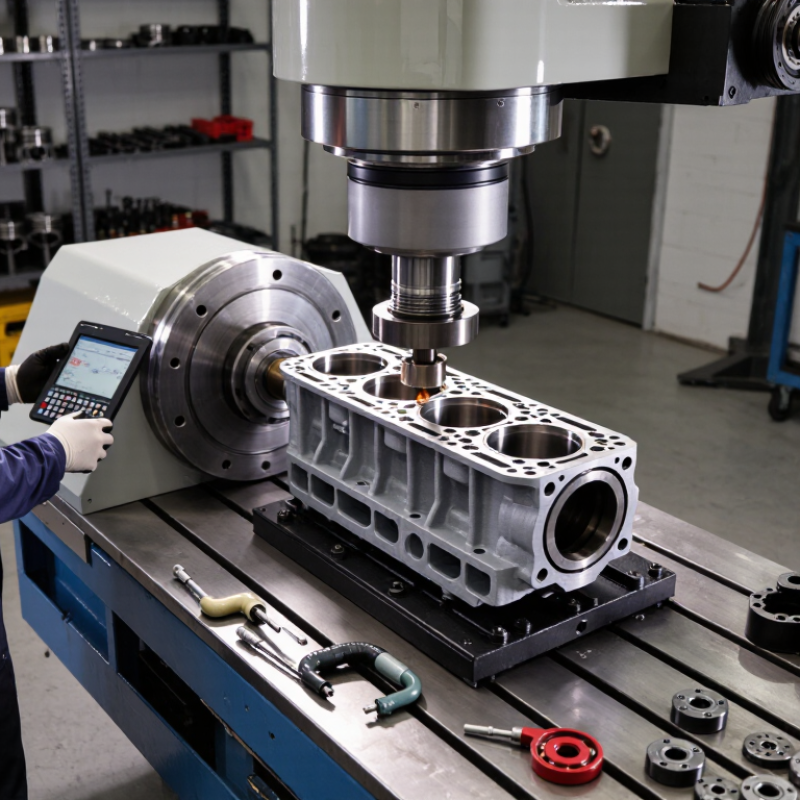
| Primary Function | Enlarges and accurately machines the internal diameter of an engine cylinder bore. | Removes wear, taper, scoring, and out-of-round conditions so the cylinder can accept the correct piston and rings. | Select a machine designed for the engine types, bore sizes, and repair tolerances handled by the workshop. |
| Common Repair Applications | Engine block rebuilding, cylinder resizing, sleeve preparation, and correction of damaged or worn bores. | Different repair jobs require different tooling, workholding methods, and measurement procedures. | Choose a versatile machine if the workload includes automotive, agricultural, industrial, or motorcycle engine blocks. |
| Typical Bore Diameter Capacity | Approximately 30–200 mm | The bore range determines whether the machine can process small engines, passenger-vehicle blocks, or larger industrial cylinders. | Compare the machine’s minimum and maximum boring diameter with the actual cylinder sizes in the workshop. |
| Typical Boring Depth | Approximately 100–500 mm, depending on machine design | The spindle travel and available working depth must cover the full length of the cylinder bore. | Confirm maximum boring depth before purchasing, especially for long-cylinder commercial or industrial engines. |
| Machining Accuracy | Common repair-shop positioning accuracy: about ±0.01–±0.02 mm | Accurate alignment and bore sizing help maintain piston clearance, ring sealing, and engine service life. | Review the manufacturer’s documented accuracy, calibration method, and recommended measurement equipment. |
| Bore Surface Finish | Rough-bored surfaces generally require honing to achieve the specified crosshatch pattern and final finish. | Boring establishes geometry and removes material; honing normally completes surface texture and final sizing. | Use boring and honing as complementary operations rather than treating boring alone as the final finishing process. |
| Spindle Speed | Common operating range: approximately 100–1,000 rpm | Speed affects cutting performance, surface quality, tool life, and compatibility with different bore diameters and materials. | Prefer adjustable speed control when machining cast iron, aluminum, steel sleeves, and different bore sizes. |
| Feed Control | Manual or powered axial feed; powered feed usually provides more consistent cutting results. | Consistent feed helps control dimensional accuracy, tool loading, and the appearance of the machined bore. | Choose powered or variable feed for repeated production work and manual feed for occasional repair jobs. |
| Machine Alignment | Adjustable worktable, centering fixtures, and alignment systems are used to position the spindle with the existing bore centerline. | Poor alignment can create an eccentric bore, uneven wall thickness, or incorrect cylinder geometry. | Prioritize rigid fixtures and accessible alignment controls when working with worn or previously repaired blocks. |
| Workpiece Size and Weight | Typical table capacities range from about 100 kg to more than 1,000 kg | The table and fixture system must safely support the complete engine block without excessive deflection. | Check table load capacity, opening dimensions, clamping range, and lifting requirements for the heaviest workpiece. |
| Typical Workpiece Materials | Gray cast iron, compacted graphite iron, aluminum alloy blocks, and replacement cylinder sleeves. | Material hardness and thermal behavior influence cutting tools, cutting parameters, and surface quality. | Verify tool compatibility and coolant requirements for the materials most frequently processed. |
| Cutting Tool Compatibility | Adjustable boring heads commonly use carbide or diamond-tipped cutting tools. | Tool material and adjustment resolution affect cutting stability, tool life, and final bore accuracy. | Choose a system with readily available inserts or cutters and precise radial adjustment. |
| Power Requirement | Common motor ratings: approximately 1.5–7.5 kW | Motor power influences the machine’s ability to maintain stable cutting under load. | Match electrical requirements to the workshop supply and consider available power for larger-diameter cuts. |
| Coolant and Chip Management | Dry cutting or flood coolant may be used according to the material, tooling, and workshop process. | Effective chip removal and temperature control can improve tool life, dimensional stability, and operator safety. | Consider an integrated coolant system, chip collection, guarding, and easy cleaning access. |
| Measurement Equipment | Dial bore gauges, inside micrometers, telescoping gauges, and precision rules are commonly used. | The machine cannot compensate for inaccurate inspection; final bore size and geometry must be verified independently. | Budget for calibrated measuring tools and inspect diameter, taper, out-of-roundness, and alignment. |
| Automation Level | Manual, semi-automatic, and CNC-controlled configurations are available. | Automation can improve repeatability and productivity but may increase purchase cost and maintenance demands. | Use manual equipment for varied low-volume repairs and automated control for repeatable high-volume work. |
| Floor Space | Compact units may require about 1–2 m²; larger systems require substantially more working clearance | Operators need safe access for loading, clamping, measurement, chip removal, and maintenance. | Measure the complete operating footprint, not only the machine dimensions shown in the specification sheet. |
| Safety Features | Recommended features include guarding, emergency stop controls, secure clamping, chip protection, and clear work lighting. | Rotating tooling, sharp chips, coolant, and heavy workpieces create significant workshop hazards. | Give preference to machines with accessible emergency controls, rigid workholding, and effective guarding. |
| Best Fit by Workload | Low-volume repair: manual machine; mixed repair work: adjustable semi-automatic machine; high-volume repeat work: CNC or automated machine. | The best configuration balances productivity, flexibility, operator skill, and total ownership cost. | Estimate annual workpiece volume, average bore size, setup time, and required repeatability before choosing the control level. |