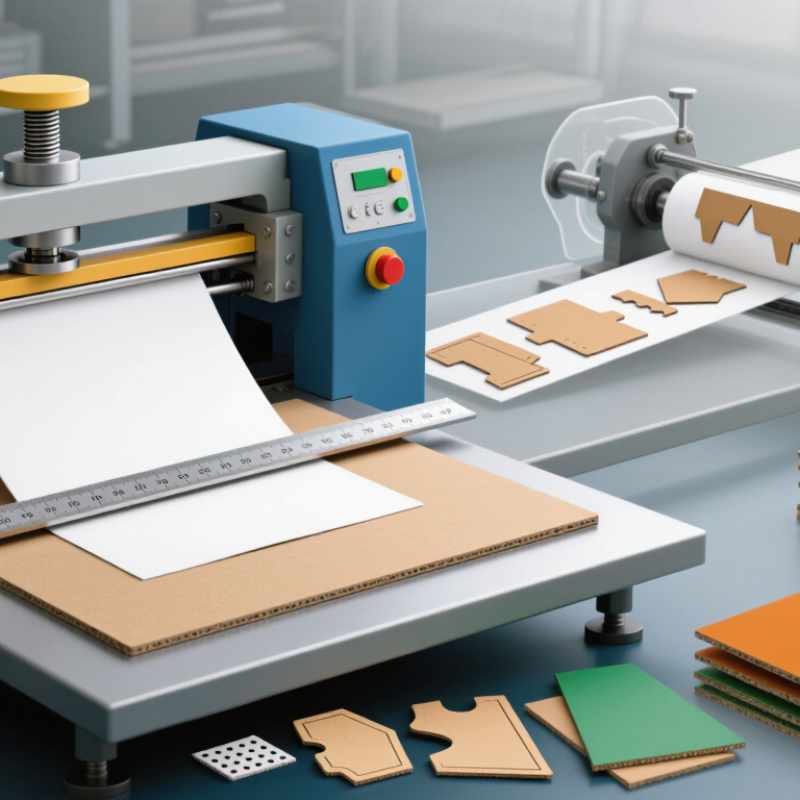
| 1 | Material Selection | The operator selects a sheet, roll, or web material according to the required thickness, flexibility, surface finish, and product function. | Material specification sheet, caliper, weighing scale | Consistent material thickness and suitable tensile strength; common materials include paperboard, corrugated board, foam, rubber, gasket sheet, film, and thin plastic. |
| 2 | Artwork and Tooling Design | The product outline is converted into a cutting layout. Cutting lines, crease lines, perforations, stripping areas, and registration marks are defined. | CAD software, die layout, steel-rule die, rotary die, or digital cutting file | The cutting path matches the final dimensions, grain direction, material thickness, and required fold or tear behavior. |
| 3 | Machine Setup | The die, cutting plate, anvil, feed system, guides, sensors, and waste-removal components are installed and aligned. | Flatbed press, rotary die cutter, digital cutter, registration system | Correct tool alignment, safe clearances, stable feeding, and accurate registration before production begins. |
| 4 | Material Feeding | The material is positioned beneath the die or passed continuously through the rotary cutting station. Guides or optical marks help maintain alignment. | Feeder, conveyor, unwind unit, nip rollers, side guides, registration sensor | Stable feed rate and repeatable positioning; misalignment can cause dimensional errors or incomplete cuts. |
| 5 | Cutting, Creasing, or Perforating | Pressure forces the cutting rule through the material. Creasing rules compress a fold line, while perforation rules create a controlled series of cuts and bridges. | Cutting die, press platen, rotary cylinder, anvil, cutting mat, or oscillating knife | Clean edges, correct cut depth, consistent crease depth, and no unwanted deformation of the finished part. |
| 6 | Waste Removal | The surrounding matrix, trim, and internal waste pieces are separated from the usable shapes. | Stripping pins, stripping board, ejector system, vacuum, waste conveyor | Finished pieces remain intact and free from excess material, while waste is collected for disposal or recycling. |
| 7 | Inspection and Adjustment | Samples are checked for dimensions, edge quality, registration, crease position, perforation performance, and surface damage. | Ruler, caliper, optical inspection system, test-fold fixture, sample checklist | Press pressure, cutting depth, feed alignment, speed, and stripping settings are adjusted if defects are found. |
| 8 | Production and Quality Control | Approved settings are used for the production run, with periodic sampling to detect tool wear, material variation, or registration drift. | Die cutting machine, production log, inspection tools, counting and stacking system | Uniform parts, controlled scrap rate, accurate counts, and documented quality results. |