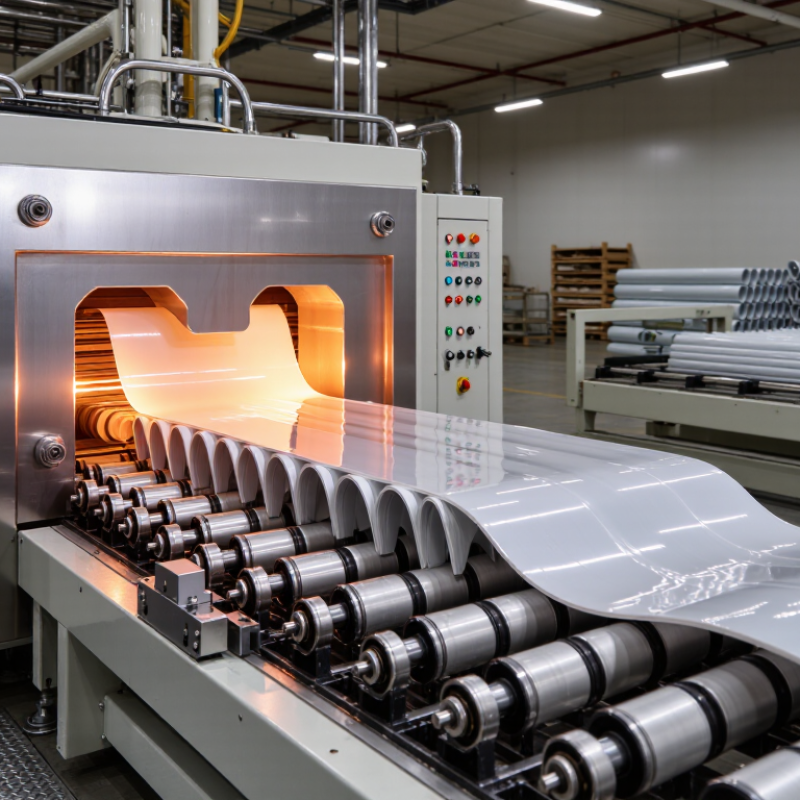
| Material | Glass-reinforced plastic (GRP), also called fiberglass-reinforced polymer | The machinery forms a resin-and-glass-fiber composite into a continuous gutter profile. |
| Common Manufacturing Method | Pultrusion is commonly used for constant cross-section profiles. | Continuous fibers are impregnated with resin, shaped through a heated die, cured, and cut to length. |
| Typical Product Length | Approximately 3–6 m per finished profile | A haul-off unit and automatic cutting system can produce repeatable lengths within the selected range. |
| Profile Geometry | U-shaped, half-round, box, deep-flow, and custom drainage sections | The die determines the fixed cross-sectional shape and dimensional consistency. |
| Typical Wall Thickness | Often about 2–5 mm, depending on design, reinforcement, and load requirements | Fiber content, resin formulation, die dimensions, and production speed influence the final thickness. |
| Reinforcement | Continuous glass rovings, mats, or a combination of both | Reinforcement improves tensile strength, stiffness, dimensional stability, and resistance to impact. |
| Resin Systems | Polyester, vinyl ester, or other thermosetting resin systems | The resin provides the matrix that binds the glass fibers and cures inside the heated forming die. |
| Main Process Stages | Fiber feeding → resin impregnation → preforming → heated die forming → curing → pulling → cutting | Each stage supports continuous production and helps maintain profile dimensions. |
| Dimensional Control | Controlled by die accuracy, fiber alignment, resin ratio, curing temperature, and pulling speed | Stable process parameters reduce warping, surface defects, and variation between sections. |
| Typical Surface Finish | Smooth, pigmented, gel-coated, or lightly textured surfaces | Surface treatment can improve appearance, weathering resistance, and cleanability. |
| Key Performance Features | Low weight, corrosion resistance, electrical non-conductivity, and good dimensional stability | These characteristics make GRP suitable for exposed drainage systems and corrosive environments. |
| Common Accessories | Outlets, running outlets, end caps, corners, brackets, connectors, and expansion components | Accessories are normally produced separately by molding, machining, or secondary fabrication. |
| Typical Applications | Industrial buildings, warehouses, commercial roofs, agricultural structures, and infrastructure projects | The profile size and reinforcement level are selected according to roof area, rainfall, span, and support spacing. |
| Quality Checks | Cross-section dimensions, length, surface condition, resin cure, fiber distribution, and straightness | Inspection confirms that each 3–6 m section meets the specified design and installation requirements. |
| Important Design Note | Exact dimensions, load capacity, flow rate, and service life vary by profile design and project conditions. | Engineering calculations and applicable building or drainage standards should be used before production and installation. |