| Manual or Compact Single-Spindle Chamfering Machine | Approximately 3–12 mm | 0°–45° | 2–20 mm | Approximately 0.5–3 m/min | Typically ±0.3–0.5 mm, depending on operator setup and glass condition | Manual positioning with basic speed and angle adjustment; limited recipe storage | Water-fed diamond wheel; compact tank and basic filtration are common | Small workshops, repair work, low-volume decorative glass, and prototypes | Low initial investment and flexible use, but lower throughput and greater dependence on operator skill |
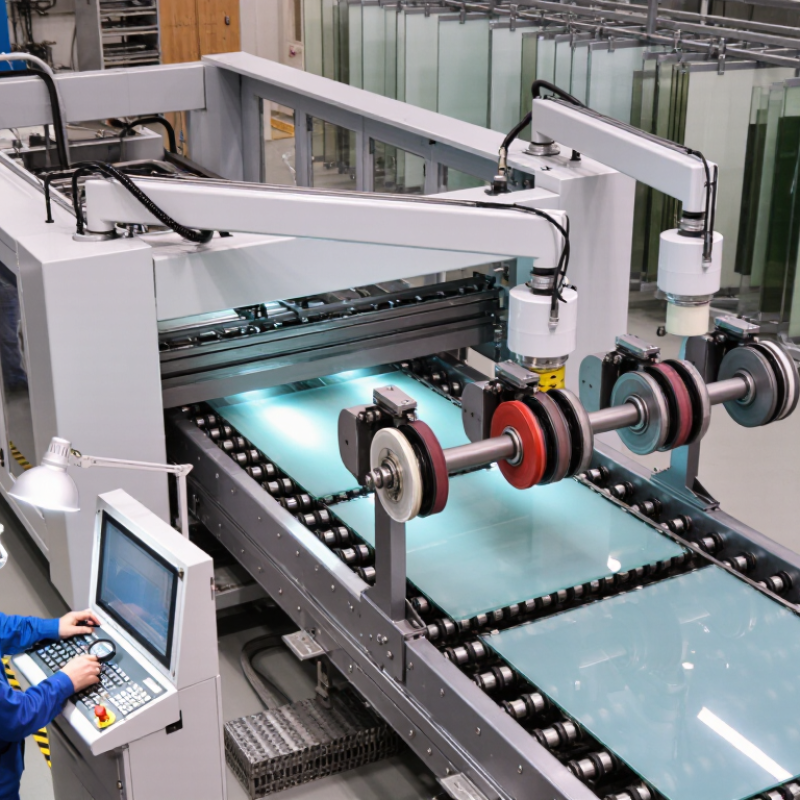
| Automatic Straight-Line Chamfering Machine | Approximately 3–25 mm | 3°–45° | 3–35 mm | Approximately 1–6 m/min | Typically ±0.2–0.3 mm for stable production conditions | Conveyor feeding, automatic glass alignment, digital parameter setting, and recipe storage | Multiple water-cooled diamond wheels with recirculation and settling filtration | Furniture glass, shower panels, architectural glass, and regular batch production | A practical general-purpose option; check conveyor stability, wheel adjustment, and maximum glass size |
| Double-Sided or Bilateral Chamfering Line | Approximately 4–25 mm | 3°–45° | 3–35 mm per side | Approximately 2–8 m/min | Typically ±0.15–0.25 mm after correct calibration | Continuous feeding with synchronized left and right processing; often includes automatic width adjustment | Independent water circuits or zoned cooling for multiple grinding stations | High-volume production requiring matched and parallel chamfers on opposite edges | High productivity and consistent symmetry, but requires more floor space, maintenance, and setup control |
| CNC Glass Chamfering and Edge-Processing Center | Approximately 3–25 mm, depending on spindle and tooling configuration | 0°–45° or wider with specialized tooling | 1–40 mm, depending on tool diameter and process | Approximately 0.5–8 m/min; cutting conditions vary by glass type and finish | Typically ±0.1–0.2 mm for programmed dimensions under controlled conditions | CNC interpolation, touchscreen or industrial controller, CAD/CAM compatibility, barcode or job-file input | Programmable water delivery, diamond tooling, and filtration sized for continuous grinding | Complex shapes, small-to-medium batches, custom architectural panels, and high-value workpieces | Best for flexibility and repeatability; requires skilled programming, tooling management, and preventive maintenance |
| Multi-Head Precision Chamfering Line | Approximately 4–30 mm, subject to machine design | 3°–45° | 3–45 mm | Approximately 3–10 m/min | Typically ±0.1–0.2 mm when glass support and calibration are well controlled | Automatic loading options, multi-stage grinding and polishing, digital monitoring, and production recipes | Several water-cooled grinding and polishing stations with centralized filtration | Large-scale architectural, solar, appliance, and furniture-glass production | High output and stable surface quality; verify line length, utility consumption, changeover time, and service access |