7 Partition Glass Buying Tips for Global Buyers

Choosing Partition Glass is not just a matter of clear panels and slim frames. Global buyers must match the product to its setting, daily use, and installation conditions. A meeting room may need acoustic privacy; a bright office may need careful glare control. The right choice starts with practical questions. How much impact resistance is required? What framing system fits the opening? How will the supplier protect glass edges during shipping? Small details matter.

This guide covers seven buying considerations, from glass type and thickness to safety documentation, hardware compatibility, packaging, and after-sales support. Ask suppliers for product data, test reports relevant to the intended use, and clear installation guidance. Compare like with like. A low quotation may exclude fittings, packing, or replacement support. Check those details before approving a sample. A close look helps. Review the glass under realistic lighting, and inspect edge quality, flatness, and any visible defects.

A useful buyer’s rule is: “Specify performance before appearance.” No verifiable source was provided for a named expert quotation, so assigning this sentence to an industry specialist would be misleading. Treat it as a practical reminder, not a published expert quote. Partition Glass can improve light flow and create flexible spaces, but only when its specification fits the project. Good decisions come from asking precise questions—and checking the answers.

7 Partition Glass Buying Tips for Global Buyers

Define Project Requirements and Partition Glass Applications

Before selecting partition glass, define the room’s job. A meeting room may need speech privacy; a reception area may need visibility and easy cleaning. Mark each partition on the plan, then record its height, door locations, expected traffic, and nearby noise sources. A floor-to-ceiling wall beside a printer needs different acoustic performance from a low divider in an open lounge. Specify whether the glass should be clear, frosted, patterned, or switchable, and check how each option affects sightlines and daylight.

Use measurable targets. Ask the design team to set an acoustic rating, such as the required sound transmission class, and confirm whether the whole assembly—including doors and perimeter seals—can meet it. The U.S. General Services Administration’s Sound Matters guidance stresses that speech privacy depends on room layout, background noise, and construction, not glass alone.

Details matter. Also check safety-glazing requirements, panel dimensions, hardware, cleaning access, and local building codes before requesting quotations.

The World Green Building Council’s 2023 Global Status Report says buildings account for 34% of global energy demand. That figure concerns buildings overall, not interior partitions; do not treat glass dividers as an energy-saving measure by themselves.

One practical detail is often missed: reflections from clear glass can make a room feel brighter, but also expose fingerprints and create visual distractions. Define the trade-offs early, even if the first specification needs revision.

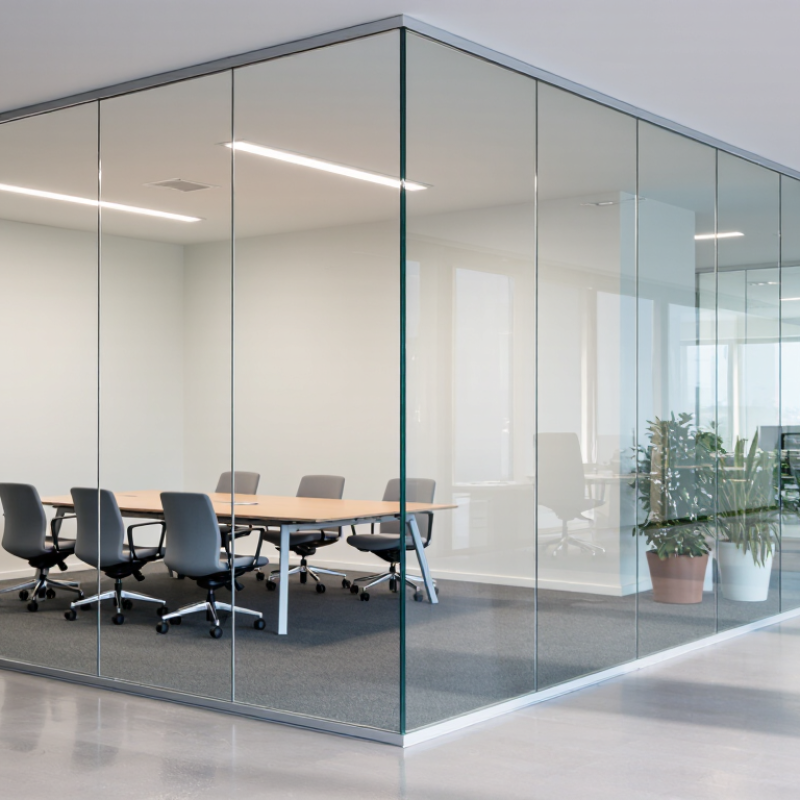
Compare Glass Types, Thicknesses, and Performance Features

Partition glass should be compared by type, thickness, and tested performance—not appearance alone. Annealed glass is economical, while heat-treated glass offers greater resistance to thermal stress and impact. Laminated glass holds fragments together after breakage and can improve sound reduction, depending on its interlayer and assembly. Thicker glass often adds stiffness and mass, but it does not guarantee better privacy. Frames, seals, panel size, and installation gaps matter too. Easy to overlook.

For acoustic targets, check the tested assembly’s rating, such as STC or Rw, rather than relying on a glass-only claim. The World Health Organization’s 2018 Environmental Noise Guidelines recommend keeping road-traffic noise below 53 dB Lden and 45 dB Lnight. These are outdoor exposure recommendations, not partition specifications, but they show why noise goals should be defined clearly. A quiet meeting room and a busy reception area need different solutions.

Ask suppliers for test reports that identify glass build-up, thickness, frame, and test method. Compare clear, tinted, and laminated options under the same lighting conditions; a sample beside a bright window can look different from one under office lighting. For safety, verify that the proposed glass type and thickness suit the panel dimensions and support system. I would not assume thicker always means quieter. Review local performance requirements, too, since accepted classifications vary between markets.

Check Safety Standards and Regional Building-Code Compliance

Partition glass can look identical while meeting very different safety requirements. Check the rules for the project’s exact location, building type, and intended use. A shower screen, office divider, and glass beside a door may face different requirements. Small detail, big consequence.

Tip: Ask for test reports, product markings, and the applicable standard in writing. Standards such as EN 12600 or ANSI Z97.1 may be relevant in some markets, but they are not universal approvals. Confirm local requirements with the project’s building professional or authority.

Check the complete assembly, not just the glass panel. Frame strength, fixing method, door hardware, and installation can affect safe performance.

Tempered glass breaks differently from laminated glass; neither choice automatically satisfies every local rule. If fire resistance or impact protection is required, verify that the tested system covers that specific use. Paperwork can be confusing, and a certificate may cover one size or configuration only. Compare it with the drawings before ordering.

Evaluate Suppliers, Product Quality, and Customization Options

For global buyers, a partition-glass supplier should provide more than a polished sample. Request documented glass build-ups, thickness tolerances, edge-finishing details, and test results for the specified acoustic rating. Ask whether the quoted performance applies to the complete partition, including frames, seals, and doors. A strong glass panel can still transmit noise through a poorly sealed joint. Check how the supplier handles packaging, replacement panels, and quality checks before shipment. Small details matter.

Customization needs engineering evidence, not just a catalog of finishes. Share clear opening dimensions, ceiling conditions, hardware preferences, and privacy needs, then ask for shop drawings and a physical sample. Confirm how changes affect lead time, cost, and tested performance. UNEP and GlobalABC’s 2023 Global Status Report for Buildings and Construction estimates that buildings and construction account for about 37% of global energy- and process-related CO₂ emissions. That figure is not specific to partition glass, but it supports asking suppliers about recycled content, material declarations, and waste reduction. I would compare those claims carefully; attractive sustainability language is not a substitute for traceable documentation. Ask for one mock-up. Check the joints in person.

Compare Total Costs, Shipping, Installation, and After-Sales Support

A partition-glass quote should show more than the panel price. Compare glass thickness, safety treatment, hardware, packaging, crating, insurance, duties, and delivery to the final site. Small parts matter. A missing clamp can delay an entire room. Ask suppliers to price the same drawings and opening dimensions, then check what is excluded. I would also keep a contingency line; access restrictions and local handling fees are easy to underestimate.

Shipping time is not just sailing time. The World Bank’s 2023 Logistics Performance Index estimates an average of 44 days from a shipment’s entry at the exporting-country port to arrival at the destination port. That is an average, not a promise. Confirm production lead time, port handling, customs clearance, and inland delivery separately. For glass, specify corner protection, crate dimensions, unloading equipment, and who pays if a crate arrives damaged. Freight can look cheap until a site lacks a suitable forklift.

Installation and after-sales support deserve their own comparison. Request a written scope covering site measurements, floor and ceiling tolerances, installer travel, sealants, cleanup, and replacement-panel procedures. Ask who responds when a door rubs or a fitting loosens, and how quickly replacement parts can be shipped. Some details will still be missed. That is worth acknowledging before purchase, not after the crew is waiting on site. Keep approved drawings, packing photos, inspection records, and warranty terms together for handover.

7 Partition Glass Buying Tips for Global Buyers

Compare Approximate Glass Weight by Thickness

Glass weight affects freight planning and installation requirements. The estimates assume glass density of 2,500 kg/m³ and exclude frames, fittings, and packaging. Compare total costs, shipping, installation, specifications, and after-sales support before choosing a supplier.

Top