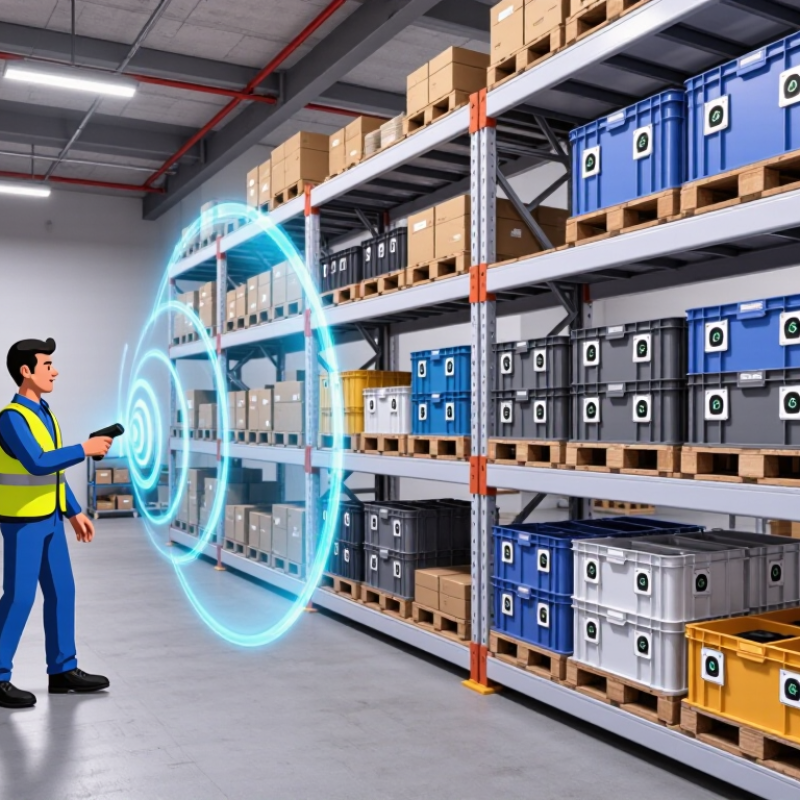
| Core Technology | Radio-frequency identification uses radio waves to identify and exchange data with tagged objects. | A reader sends a radio signal, the tag responds with stored identification data, and software associates the response with an asset record. | Automated asset identification, location updates, inventory checks, and movement monitoring. | RFID identifies assets without requiring direct line-of-sight scanning. |
| Tag Type | Passive | The tag has no internal battery. It receives operating energy from the reader's radio field and reflects a modulated signal back. | Low-cost item identification, inventory control, tool tracking, and access-controlled asset handling. | Read range and reliability depend on frequency, reader power, antenna design, tag orientation, and surrounding materials. |
| Tag Type | Active | The tag contains a battery and can transmit a stronger signal or send data at scheduled intervals. | Long-range tracking of vehicles, containers, high-value equipment, and assets requiring periodic status updates. | Usually offers greater range but has a larger physical size, higher cost, and limited battery life. |
| Tag Type | Battery-Assisted Passive | A battery powers the tag's internal electronics, while communication is still initiated through a reader's signal. | Tracking assets that need improved read performance, sensing, or operation near challenging materials. | Performance and battery life vary according to the tag design and operating environment. |
| Common Frequency Band | Low frequency (LF), typically around 125–134 kHz | Uses magnetic coupling between the reader and tag. | Short-range identification, animal identification, and applications requiring good performance around liquids. | Generally provides a shorter read distance and lower data rate than higher-frequency systems. |
| Common Frequency Band | High frequency (HF), typically 13.56 MHz | Uses inductive coupling and can support short-range data exchange. | Document tracking, library materials, contactless identification, and item-level applications. | Read range is generally short and can be affected by metal and liquid environments. |
| Common Frequency Band | Ultra-high frequency (UHF), commonly within the 860–960 MHz range | Uses electromagnetic backscatter, allowing a reader to identify multiple tags at a distance. | Warehouse inventory, supply-chain tracking, pallet monitoring, and high-throughput asset counting. | Regional regulations, reader configuration, tag placement, nearby metal, and liquid can affect performance. |
| Tag Memory | Unique identifier and optional user memory | The chip stores a serial number or electronic identifier. Some tags also store writable data such as an asset code, maintenance state, or production batch. | Links the physical tag to a digital asset record and can support limited on-tag data storage. | Memory capacity, write endurance, data format, and lock features differ by tag design. |
| Data Transmission | Backscatter response or powered radio transmission | Passive tags change the characteristics of the reader's signal to encode a response. Active tags use their battery to transmit data. | Transfers the tag identifier and available stored data to the reader. | RFID tags typically do not communicate directly with cloud software; the reader and connected system handle that exchange. |
| Reader Function | Interrogates tags and captures tag responses | The reader emits radio energy, receives tag replies, filters duplicate reads, and forwards event data to an information system. | Creates records such as asset seen, asset entering a zone, or asset leaving a checkpoint. | Reader placement, antenna coverage, power settings, and shielding influence read accuracy. |
| Asset Information | Asset ID, category, status, location event, time, and reader zone | The RFID identifier is matched with an asset database containing descriptive and operational information. | Shows which asset was detected, when it was detected, and where the detection occurred. | RFID provides an identification event; precise real-time location may require multiple readers, portals, antennas, or complementary technologies. |
| Read Method | Fixed reader, handheld reader, or integrated reader | Fixed readers monitor defined areas, handheld readers support mobile searches, and integrated readers can be built into equipment or gates. | Automated checkpoints, cycle counts, field inspections, and locating tagged assets. | The best reader type depends on asset volume, movement pattern, required range, and operating environment. |
| Material Compatibility | Paper, plastic, fabric, metal, and liquid environments require different tag designs. | Metal can detune an antenna, while liquid can absorb or weaken radio energy, especially at higher frequencies. | Supports tagging of equipment, containers, garments, tools, and packaged goods. | Tags designed for metal or liquid-facing applications may use spacers, special antennas, or protective housings. |
| Operational Benefits | Fast, non-line-of-sight identification of multiple assets | A reader can capture several tag responses during one scan event, subject to system configuration and the surrounding environment. | Reduces manual counting, improves audit visibility, and supports more frequent inventory updates. | RFID improves data capture but does not eliminate the need for correct tagging, system integration, and process controls. |
| Security and Privacy | Access control, password protection, data minimization, and tag deactivation options | Depending on the tag and system, memory can be locked, protected, or cleared, and reader access can be controlled. | Protects asset data and limits unauthorized reading or modification. | Security capabilities vary; sensitive information is commonly kept in the back-end system rather than stored directly on the tag. |