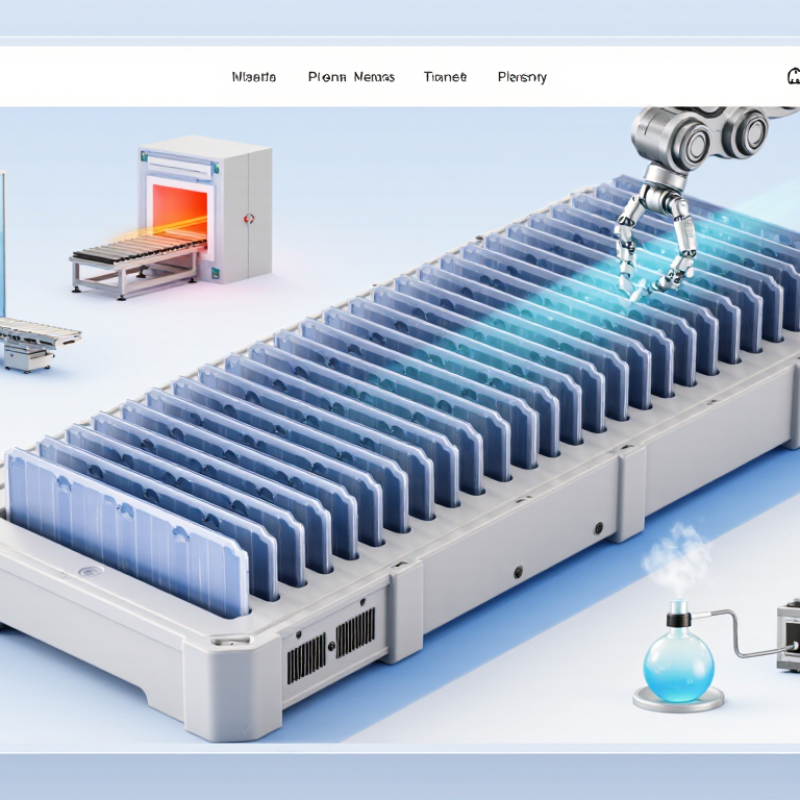
| Cassette frame | Polypropylene, polycarbonate, PEEK, or quartz, depending on process temperature and chemical exposure | Provides the structural support that keeps the cassette square, stable, and compatible with handling equipment. | Must resist warping, cracking, contamination, and repeated thermal or chemical cycles. |
| Wafer or cell slots | Usually a series of evenly spaced horizontal or angled slots; common pitch ranges from about 4 mm to 10 mm | Separates individual wafers or cells so their surfaces do not touch during transport and processing. | Slot width and pitch must match the workpiece thickness and prevent excessive movement. |
| Sidewalls and guides | Rigid molded or machined supports with smooth, rounded contact surfaces | Align the wafers or cells laterally and prevent them from sliding out of position. | Smooth surfaces reduce edge chipping, scratches, and particle generation. |
| Base support | Flat or ribbed base designed to support the lower edges of the workpieces | Transfers the weight of the wafers or cells to the cassette body and maintains their vertical or angled orientation. | The base should allow process fluids or gases to drain or circulate when required. |
| Top restraint or retaining bar | Optional removable bar, cover, or upper guide | Limits upward movement and keeps thin wafers or cells secure during vibration, rotation, or robotic movement. | It must hold the workpieces without applying damaging point pressure to their surfaces or edges. |
| Handling interface | Defined gripping surfaces, slots, rails, or robot-access openings | Allows automated equipment to pick up, move, load, and unload the cassette consistently. | Interface dimensions must be controlled to ensure repeatable positioning and safe robotic access. |
| Identification area | Label recess, barcode area, RFID location, or engraved identification zone | Links the cassette to a production batch, process route, cleaning record, or inspection history. | Identification should remain readable after cleaning and exposure to process chemicals. |
| Drainage and ventilation openings | Open-frame passages or perforations sized for liquid drainage and gas circulation | Helps cleaning solutions, rinses, heated air, or process gases reach the workpiece surfaces and leave the cassette. | Openings must balance efficient flow with adequate mechanical support. |
| Workpiece capacity | Commonly about 25 to 200 wafers or cells, depending on cassette size, slot pitch, and process type | Determines the number of workpieces that can be transferred or processed as one batch. | Higher capacity improves throughput but increases weight, handling load, and the risk of contact if alignment is poor. |
| Workpiece compatibility | Designed for specific wafer or cell formats, commonly square or rectangular silicon pieces | Ensures that the carrier supports the intended dimensions, thickness, edge shape, and orientation. | A cassette designed for one format may not safely accommodate another without changing slot geometry. |
| Chemical resistance | Selected according to exposure to alkaline cleaners, acids, solvents, deionized water, or plating chemicals | Prevents the carrier from swelling, embrittling, contaminating the process, or losing dimensional accuracy. | Material compatibility should be verified for concentration, temperature, and exposure time. |
| Thermal capability | Process-dependent; polymers are used for moderate temperatures, while quartz or specialized materials suit higher-temperature steps | Maintains cassette geometry during heating, drying, diffusion, or other thermal operations. | Thermal expansion and heat-transfer behavior can affect slot alignment and workpiece stress. |
| Surface cleanliness | Low-particle, low-metal-contamination surface suitable for the manufacturing environment | Reduces the transfer of particles, residues, and metallic contaminants onto wafers or cells. | Regular inspection and validated cleaning procedures are essential for stable yield. |
| How it works in production | Load → transport → process → inspect → unload or transfer | Maintains separation, orientation, traceability, and mechanical protection throughout multiple manufacturing steps. | The cassette does not generate electricity; it is a process carrier that protects and organizes the photovoltaic workpieces. |