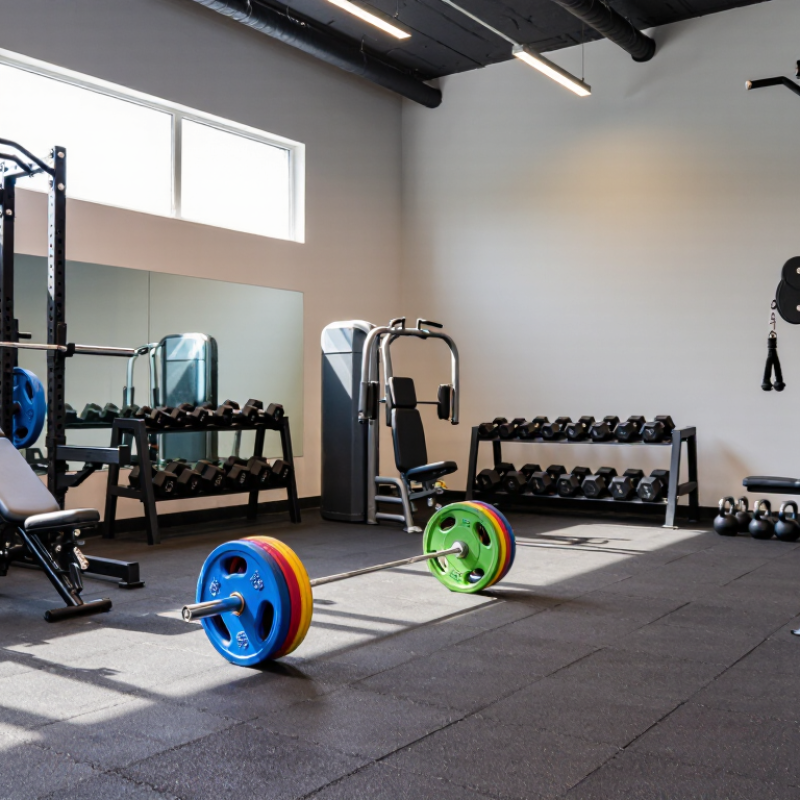
| Free Weights | Barbells, weight plates, dumbbells, kettlebells, adjustable dumbbells | - Maximum strength
- Muscle hypertrophy
- Power and athletic performance
- Compound movement development
| - Allow a broad range of exercises and movement patterns
- Require the user to stabilize the load
- Can be progressively loaded in small or large increments
- Efficient for full-body training
| - Technique and supervision may be important for beginners
- Weights can be dropped or misplaced if storage is poor
- Some exercises require a rack, bench, or lifting platform
| Beginners with instruction, intermediate lifters, advanced athletes, and home or commercial gyms | Load range, grip comfort, adjustability, storage, floor protection, and available safety equipment |
| Selectorized Machines | Weight-stack press machines, leg-extension machines, row machines, pulley-guided machines | - Muscle hypertrophy
- General strength development
- Accessible resistance training
- Controlled rehabilitation-oriented exercise when professionally prescribed
| - Guided paths can simplify exercise setup
- Resistance is easy to adjust between sets
- Useful for isolating or emphasizing specific muscle groups
- Often provide built-in safety stops
| - Movement path may not suit every body shape
- Usually supports fewer exercise variations than free weights
- Can require substantial floor space
| Beginners, general fitness users, older adults, and experienced trainees seeking targeted work | Adjustability, seat and pad dimensions, range of motion, smoothness, accessibility, and maintenance |
| Cable and Pulley Systems | Adjustable cable stations, dual-pulley systems, lat pulldown stations, low-row stations | - Hypertrophy
- Upper-body and lower-body strength
- Unilateral training
- Functional movement and sport-specific patterns
| - Provide resistance through many angles
- Support pressing, pulling, rotation, and anti-rotation exercises
- Enable independent training of each side of the body
- Offer smooth, continuous resistance when properly maintained
| - Require adequate ceiling height and operating space
- Cables, pulleys, and attachments need regular inspection
- Some systems have limited maximum loading
| Home users with sufficient space, personal-training studios, athletes, and general fitness users | Cable travel, pulley ratio, maximum load, attachment options, adjustment range, and frame stability |
| Resistance Bands and Tubes | Loop bands, therapy-style bands, tube bands with handles, fabric resistance bands | - General strength and muscular endurance
- Warm-ups and activation work
- Mobility-supporting exercises
- Travel and home workouts
| - Lightweight, portable, and relatively low-cost
- Can be used for many upper-body, lower-body, and core exercises
- Provide increasing tension as the band is stretched
- Require little storage space
| - Resistance is difficult to measure precisely
- Anchor points must be secure
- Elastic materials can wear, snap, or lose tension over time
| Beginners, travelers, rehabilitation users under guidance, and home exercisers | Resistance levels, material quality, length, handle design, anchor security, and signs of wear |
| Bodyweight and Suspension Equipment | Pull-up bars, parallel bars, suspension straps, gymnastic rings, push-up handles | - Relative strength
- Core stability
- Grip strength
- Body control and movement coordination
| - Uses the user's body mass as resistance
- Supports compound movements and stabilization demands
- Usually requires little or no external loading
- Can be adapted by changing body angle, leverage, or range of motion
| - Progression can be challenging for some movements
- Requires adequate grip, joint control, or foundational strength
- Suspension systems depend on a reliable anchor point
| Beginners using regressions, calisthenics trainees, athletes, and travelers | Anchor strength, height adjustment, handle comfort, load rating, clearance, and exercise progression |
| Functional Training Equipment | Medicine balls, sandbags, sleds, battle ropes, plyometric boxes, landmine attachments | - Power and explosive strength
- Conditioning combined with resistance
- Work capacity and athletic movement
- Coordination and force transfer
| - Supports dynamic, multi-joint movement
- Can combine strength, speed, balance, and conditioning
- Useful for varied group or individual sessions
- Many tools can be used indoors or outdoors
| - Technique and space management are important
- Some tools are difficult to quantify for progressive loading
- High-impact exercises may not suit every user or floor
| Athletes, coaches, group-training participants, and experienced general fitness users | Intended movement, load or weight, impact level, floor surface, available space, and user skill |
| Specialty Strength Equipment | Squat racks, power cages, lifting benches, deadlift platforms, dip stations, specialty bars | - Heavy compound lifting
- Strength sport preparation
- Progressive overload
- Structured barbell training
| - Can support heavier loads when correctly installed and used
- Safety arms, uprights, and benches can improve training control
- Creates a stable setup for major compound lifts
- Allows systematic progression and exercise customization
| - Needs more space and usually more setup time
- Requires attention to installation, alignment, and load limits
- May be excessive for users seeking only light general exercise
| Intermediate and advanced lifters, strength-focused home gyms, and training facilities | Rated capacity, rack dimensions, safety-stop adjustment, bench stability, floor anchoring, and bar clearance |