| 1 | Passenger Lift | Office buildings, hotels, retail centres, apartment buildings and public facilities | 630–2,000 kg
8–26 passengers | 1.0–3.5 m/s | Electric traction; geared or gearless configurations | Efficient everyday movement of people, flexible cabin sizes and broad code availability | Traffic analysis, accessibility, peak-time waiting periods and the number of floors determine the required quantity and capacity |
| 2 | High-Speed Lift | High-rise offices, residential towers, hotels and mixed-use skyscrapers | 1,000–2,500 kg | 3.5–10 m/s | High-performance gearless traction with advanced control systems | Shorter travel times and improved service for buildings with many storeys | Requires careful control of vibration, noise, pressure changes, heat, emergency operation and vertical-transport zoning |
| 3 | Service Lift | Hotels, hospitals, offices, restaurants, schools and retail properties | 1,000–2,500 kg | 0.63–2.5 m/s | Traction or hydraulic drive, depending on building height and duty cycle | Separates deliveries, cleaning equipment and staff movement from public passenger traffic | Cabin finishes should resist impact, moisture and frequent loading; access control may be required |
| 4 | Freight Lift | Warehouses, factories, distribution centres, shopping centres and logistics facilities | 2,000–10,000 kg | 0.25–1.0 m/s | Heavy-duty traction or hydraulic drive | Handles pallets, trolleys, industrial loads and repeated loading cycles | Requires reinforced floors, robust doors, loading-clearance planning, impact protection and suitable ventilation |
| 5 | Hospital or Bed Lift | Hospitals, clinics, care homes and medical research buildings | 1,600–2,500 kg
21–33 passengers | 1.0–2.5 m/s | Electric traction, commonly with smooth-start and smooth-stop controls | Accommodates beds, medical teams, equipment and accompanying visitors in a controlled ride | Cabin dimensions, stretcher clearance, hygiene, emergency power, fire-service operation and infection-control requirements are critical |
| 6 | Machine-Room-Less (MRL) Lift | Commercial offices, hotels, low- to mid-rise buildings and modern refurbishments | 630–2,000 kg | 1.0–2.5 m/s | Compact gearless traction equipment installed within the hoistway | Reduces the need for a separate machine room and can improve building-space efficiency | Maintenance access, heat dissipation, rescue procedures and local code requirements must be addressed during design |
| 7 | Hydraulic Lift | Low-rise commercial buildings, small offices, retail premises and accessible entrances | 450–2,000 kg | 0.15–0.75 m/s | Hydraulic piston and pump system | Suitable for low-rise travel, provides strong lifting force and can offer flexible structural arrangements | Generally has lower speed and higher energy use during upward travel; pit depth, oil equipment and environmental protection require planning |
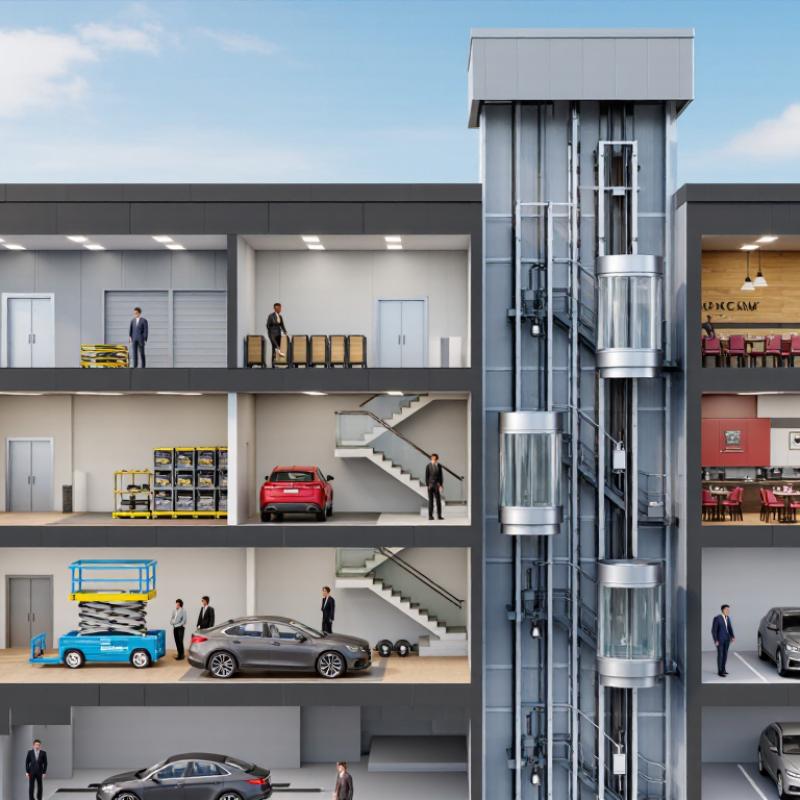
| 8 | Panoramic or Glass Lift | Shopping centres, hotels, museums, atriums and visitor attractions | 630–1,600 kg | 0.63–2.5 m/s | Traction drive; hydraulic systems may be used for low-rise installations | Provides visibility, supports architectural design and can improve wayfinding in public spaces | Glass safety, glare, solar heat, cleaning access, lighting, privacy and structural integration must be considered |
| 9 | Vertical Platform Lift | Small commercial buildings, public facilities and premises requiring step-free access over limited levels | 225–450 kg | 0.10–0.20 m/s | Screw, hydraulic or electro-mechanical drive | Provides wheelchair and mobility access where a conventional passenger lift may be impractical | Travel height, platform dimensions, guarding, weather protection, landing gates and accessibility regulations affect the design |
| 10 | Dumbwaiter or Small Goods Lift | Restaurants, hotels, libraries, offices, laboratories and retail premises | 50–300 kg | 0.2–1.0 m/s | Electric traction or compact screw-driven mechanism | Moves food, documents, stock and small materials efficiently between floors without using passenger lifts | Load dimensions, fire-rated landing doors, cleaning requirements, interlocks and separation from passenger traffic are important |