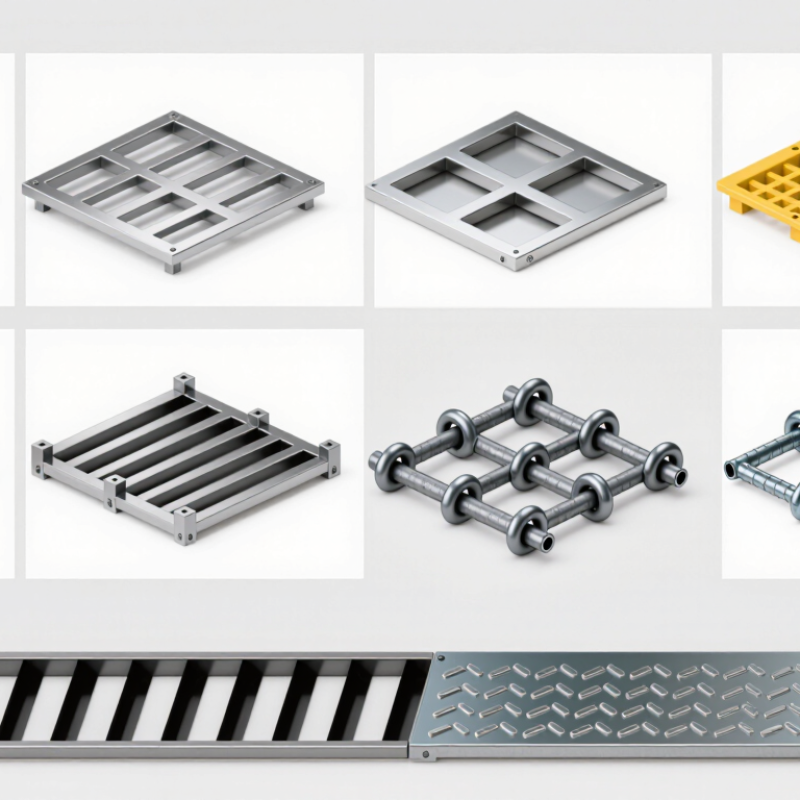
| 1 | Welded Bar Grating | Load-bearing bars are welded to perpendicular cross bars at their intersections. | Carbon steel Stainless steel Aluminum | Resistance welding; commonly supplied with plain or serrated bearing bars. | Classified by bearing-bar depth, thickness, spacing, cross-bar spacing, and surface profile. | Industrial walkways, platforms, mezzanines, equipment floors, stair treads, and drainage covers. | High stiffness, dependable load transfer, open drainage, and relatively low weight compared with solid plate. | Confirm the required span, concentrated load, pedestrian traffic, corrosion exposure, and deflection limit. |
| 2 | Press-Locked Grating | Cross bars are mechanically forced into pre-punched slots in the bearing bars. | Carbon steel Stainless steel Aluminum | Pressure-locked assembly; cross bars may be square, rectangular, or round. | Classified by locking method, bar shape, panel geometry, spacing, and bearing-bar dimensions. | Architectural floors, ventilation screens, platforms, ceiling panels, and areas requiring a uniform appearance. | Clean visual lines, good lateral stability, and flexible panel design. | Check resistance to impact, twisting, vibration, and corrosive conditions because performance depends on the joint design. |
| 3 | Swage-Locked Grating | Cross bars are inserted through punched bearing bars and mechanically expanded to lock them in position. | Aluminum Steel Stainless steel | Swaging or mechanical deformation creates a rigid connection at each crossing point. | Classified by cross-bar profile, bar spacing, material, and connection configuration. | Good visual uniformity, strong panel integrity, and suitability for many lightweight floor systems. | Evaluate joint security, load direction, panel support, and compatibility with the selected material. |
| 4 | Riveted Grating | Rivets connect the bearing bars and cross bars, often using tubular or solid rivet arrangements. | Carbon steel Stainless steel | Mechanical riveting; often combined with serrated bearing bars for improved slip resistance. | Classified by rivet pattern, bearing-bar profile, cross-bar design, and panel load rating. | Heavy-duty walkways, bridges, industrial platforms, and locations subject to vibration or impact. | Robust mechanical connections and good resistance to repeated service loads. | Inspect rivet condition, bearing support, corrosion protection, and access for maintenance. |
| 5 | Serrated-Surface Grating | Any compatible grating panel with serrations cut or formed into the upper surface of the bearing bars. | Steel Stainless steel Aluminum | Serrations may be applied to the full bearing bar or to selected areas of the walking surface. | Classified primarily by anti-slip surface pattern, bar profile, pitch, and base grating construction. | Improved traction in wet, oily, muddy, or snowy environments. | Consider footwear, contamination type, cleaning requirements, sharp-edge exposure, and accessibility needs. |
| 6 | Smooth-Surface Grating | Grating with plain, non-serrated upper bearing-bar surfaces. | Carbon steel Stainless steel Aluminum | Plain rolled, extruded, or fabricated bearing bars without raised serrations. | Classified by open-area ratio, bar spacing, load-bearing dimensions, and surface finish. | Dry indoor platforms, architectural floors, removable access panels, and areas requiring easy cleaning. | Smoother walking surface, convenient cleaning, and reduced risk of snagging small objects. | Use only where slip risk is controlled; assess water, oil, ice, and other contaminants before selection. |
| 7 | Heavy-Duty Grating | Grating manufactured with deeper or thicker bearing bars and closer support requirements for higher loads. | Carbon steel Stainless steel | Usually welded, press-locked, or riveted, with load-bearing members sized for demanding service. | Classified by design load, span, bearing-bar size, panel support, and allowable deflection. | Vehicle-access areas, loading platforms, industrial floors, heavy equipment zones, and trench covers. | Higher load capacity and increased resistance to impact when correctly supported. | Design must account for wheel loads, point loads, dynamic effects, support conditions, and local structural codes. |
| 8 | Light-Duty Grating | Grating using smaller or thinner bearing bars for pedestrian or low-load applications. | Aluminum Steel Fiberglass | Commonly molded, pultruded, welded, or mechanically locked, depending on the material. | Classified by pedestrian load rating, panel thickness, open area, and support span. | Low self-weight, easier handling, and efficient ventilation or drainage for lightly loaded areas. | Ceilings, service platforms, walkways, inspection areas, and access panels. | Do not substitute it for vehicle or heavy-equipment service; verify span and expected concentrated loads. |
| 9 | Fiberglass-Reinforced Plastic Grating | Glass fibers embedded in a resin matrix form load-bearing bars and cross members. | FRP Vinyl ester resin Polyester resin | Molded or pultruded construction; surfaces may include grit or integral anti-slip particles. | Classified by resin type, fiber orientation, manufacturing process, mesh size, thickness, and surface finish. | Corrosion resistance, electrical non-conductivity, low maintenance, and easy field handling. | Chemical plants, wastewater facilities, marine areas, food-processing zones, and electrical work areas. | Check chemical compatibility, UV exposure, fire performance, temperature range, creep, and required load span. |
| 10 | Expanded Metal Grating | A single sheet is slit and stretched to form interconnected diamond-shaped openings. | Carbon steel Stainless steel Aluminum | Manufactured without separate cross bars; mesh size and strand dimensions define the panel structure. | Classified by long-way opening, short-way opening, strand width, strand thickness, and panel orientation. | Continuous surface, good lateral rigidity, ventilation, and efficient material use. | Machine guards, walkways, platforms, ramps, screens, and general access flooring. | Verify walking comfort, opening size, edge safety, slip resistance, support spacing, and load capacity. |