| Orbital TIG Pipe Welding Machine | 6–168 mm | 0.8–8 mm | Automatic GTAW/TIG, with or without filler wire | Approximately 20–80 joints per shift, depending on diameter and wall thickness | Stainless steel, carbon steel, duplex steel, nickel alloys | High-integrity tubing, food processing, pharmaceutical, semiconductor, and power piping | Choose closed-head equipment for clean tubing and open-head equipment for larger or irregular assemblies. Confirm shielding-gas control and data recording functions. |
| Automatic MIG/MAG Pipe Welding Machine | 60–610 mm | 3–25 mm | GMAW/MIG or MAG, including pulsed transfer | Approximately 40–140 joints per shift | Carbon steel, stainless steel, low-alloy steel | Fabrication shops, structural pipe, process piping, and medium-volume industrial production | Match wire diameter, torch access, travel speed, and position control to the joint design. Pulsed welding can reduce spatter and improve control on stainless steel. |
| Narrow-Gap Automatic Pipe Welding System | 300–1,220 mm | 20–100 mm | Narrow-gap GTAW, GMAW, or hybrid multi-process welding | Approximately 6–25 large-diameter joints per shift | Carbon steel, low-alloy steel, stainless steel | Heavy-wall pipelines, power plants, refineries, and large pressure vessels | A narrow groove reduces filler metal and heat input, but accurate machining, fit-up, seam tracking, and multi-layer control are essential. |
| Automatic Submerged Arc Pipe Welding Machine | 400–2,400 mm | 8–60 mm | SAW, generally used for longitudinal or circumferential seams | Approximately 10–35 large-diameter joints per shift | Carbon steel and low-alloy steel | Large pipe mills, transmission pipe, water pipelines, and heavy fabrication | Requires flux handling and recovery. Verify welding position, wire-feed capacity, travel mechanism, and compatibility with the pipe rotator. |
| Pipe-Fit-Up and Tack-Welding Machine | 168–1,420 mm | 5–35 mm | Automatic or semi-automatic GMAW tack welding | Approximately 20–80 fitted and tack-welded joints per shift | Carbon steel, stainless steel, low-alloy steel | Pipeline assembly lines and workshops where fit-up consistency limits final welding speed | Prioritize hydraulic clamping force, alignment accuracy, root-gap control, and quick changeover between pipe diameters. |
| Rotator-Based Circumferential Welding Machine | 80–2,000 mm | 4–40 mm | MIG/MAG, TIG, FCAW, or SAW with a fixed welding torch | Approximately 15–60 joints per shift | Carbon steel, stainless steel, aluminum, low-alloy steel | General fabrication, flanges, elbows, reducers, tanks, and pipe spool production | Select self-aligning or conventional rotators according to load variation. Check minimum diameter, maximum load, rotation accuracy, and torch-adjustment range. |
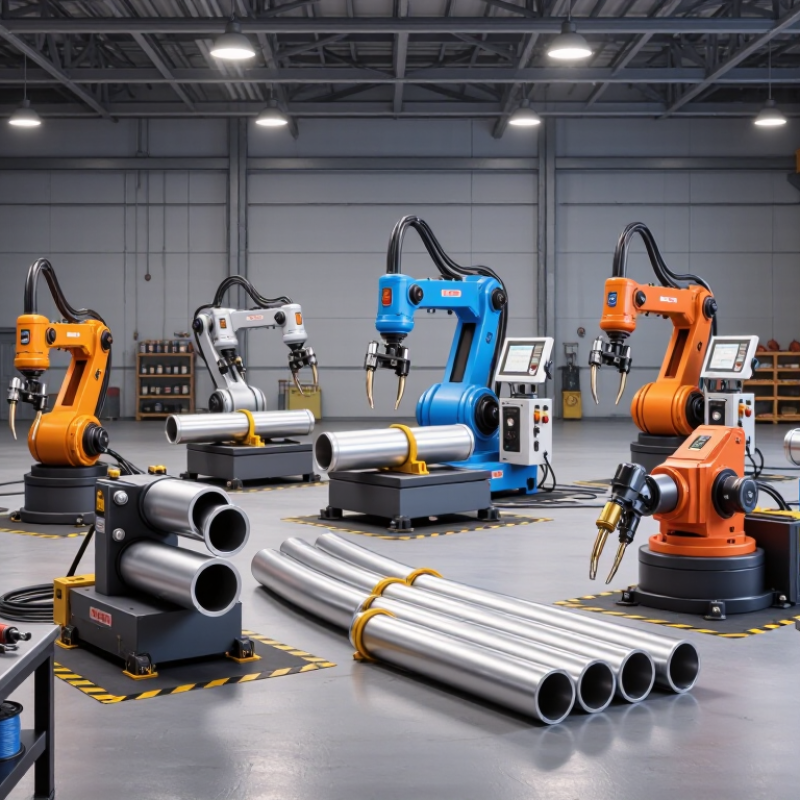
| Robotic Pipe Welding Cell | 50–1,000 mm | 2–30 mm | Robotic GMAW/MAG, TIG, or hybrid process | Approximately 30–120 joints per shift, depending on part mix and cycle time | Carbon steel, stainless steel, aluminum, nickel alloys | Repeatable pipe spools, fittings, manifolds, and high-volume engineered products | Best for stable product designs and high utilization. Include seam tracking, positioners, safety guarding, offline programming, and operator training in the budget. |