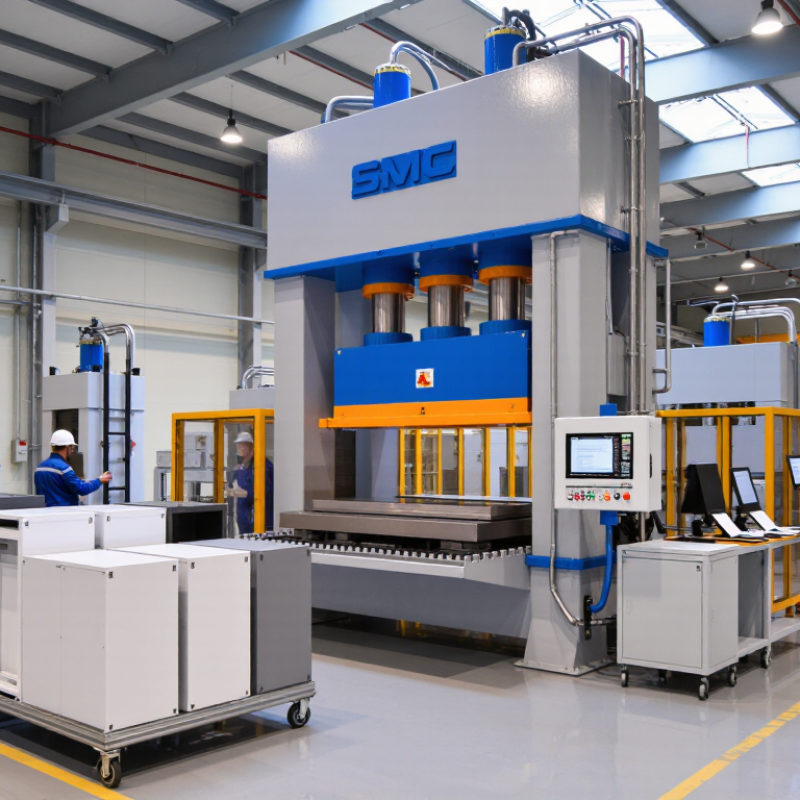
| Press Structure | Four-column or welded-frame body | Four-column, H-frame, or fabricated steel construction | Supports the mold, cylinder, and hydraulic loads while maintaining platen alignment during molding. |
| Main Hydraulic Cylinder | Double-acting ram cylinder | Nominal force commonly 1,000–10,000 kN; stroke commonly 300–1,000 mm | Converts hydraulic pressure into linear pressing force for mold closing, curing, and mold opening. |
| Hydraulic Power Unit | Motor, hydraulic pump, reservoir, valves, and filters | System pressure often 160–250 bar; filtration commonly 10–25 μm | The pump supplies pressurized oil, while control valves regulate flow direction, speed, and pressure. |
| Pressing Force | Molding force and pressure control | Typical SMC molding pressure: approximately 50–150 bar at the material or mold interface, depending on part design and process conditions | Controlled force consolidates the sheet molding compound and fills the mold cavity without excessive flash or fiber disturbance. |
| Upper and Lower Platens | Rigid heated mold mounting plates | Typical platen temperature range: 120–180°C; flatness and parallelism depend on machine design | Hold and heat the mold halves. Even temperature distribution supports consistent curing and dimensional stability. |
| Heating System | Electric cartridge heaters, oil heating, or water heating | Temperature control accuracy commonly within ±2–5°C, depending on sensor layout and controller | Raises the mold to the curing temperature required by the thermosetting resin system used in the SMC compound. |
| Mold | Matched metal mold for enclosure geometry | Usually manufactured from tool steel or other suitable mold-grade steel; cavity design includes ribs, bosses, and draft angles | Shapes the SMC charge into the enclosure body, cover, mounting features, and internal reinforcement structures. |
| Control System | PLC, touchscreen interface, pressure sensors, and temperature controllers | Programmable control of pressure, position, speed, temperature, dwell time, and alarm limits | Coordinates the molding cycle and records key process values for repeatability and quality monitoring. |
| Position Measurement | Linear transducer or proximity-based position sensors | Monitors ram position, mold opening, closing, and final compression distance | Helps control closing speed, protect the mold, and maintain consistent part thickness. |
| Guiding System | Guide columns, guide sleeves, and wear plates | Designed to maintain platen parallelism and reduce lateral mold movement | Guides the moving platen and distributes load evenly across the mold during compression. |
| Ejector System | Hydraulic or mechanical ejector pins | Ejection force and stroke are selected according to enclosure size, draft, and mold adhesion | Separates the cured enclosure from the mold after the press opens, minimizing deformation and surface damage. |
| SMC Material | Sheet molding compound | Thermosetting resin matrix reinforced mainly with chopped glass fibers and mineral fillers | The pre-impregnated compound flows under heat and pressure, then cures into a rigid composite part. |
| Typical Cycle Sequence | Charge placement, closing, compression, curing, opening, and ejection | Cycle time commonly ranges from approximately 1–10 minutes, depending on part thickness, resin system, and mold temperature | A controlled sequence ensures complete cavity filling, adequate curing, stable dimensions, and safe part removal. |
| Enclosure Applications | Electrical, control, telecommunications, and industrial enclosures | Common requirements include insulation, corrosion resistance, flame resistance, weather resistance, and dimensional stability | SMC compression molding produces strong, lightweight housings with integrated ribs, mounting points, and sealing features. |
| Safety and Maintenance | Light curtains, interlocks, emergency stop, oil inspection, and mold cleaning | Safety design should comply with applicable machinery and electrical safety requirements in the target market | Protects operators and equipment while maintaining hydraulic performance, mold cleanliness, and stable production quality. |