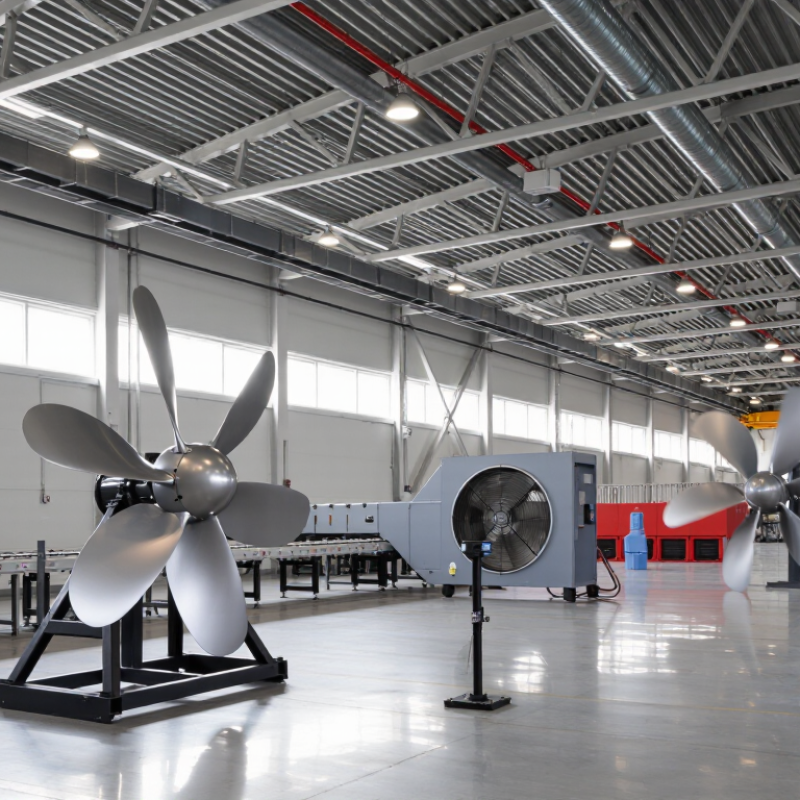
| Axial-flow fan | General ventilation, equipment cooling, and moving large volumes of relatively clean air through low-resistance systems. | Air travels approximately parallel to the fan shaft; commonly supplied as propeller, tube-axial, or vane-axial designs. | Compact installation and high airflow capacity for applications with comparatively low system resistance. | Check the system pressure requirement, duct layout, noise limits, and operating point. Axial fans may be unsuitable where filters or long duct runs create high resistance. |
| Backward-curved centrifugal fan | Process exhaust, clean-air supply, and ventilation systems requiring moderate to high pressure. | Curved blades turn air outward from the impeller; often selected for systems with ductwork, filters, or other resistance. | Efficient operation is possible when the fan is correctly selected and operated near its intended duty point. | Confirm airflow, total pressure, fan speed, motor power, and the system curve. It is generally intended for relatively clean gas unless specifically designed for particulate service. |
| Radial-blade centrifugal fan | Dust-laden exhaust, material handling, and other services involving heavier particulate loads. | Straight or radial blades and a robust wheel design; some configurations provide wider passages for particle-laden air. | Can be suited to demanding particulate applications and may be more tolerant of material buildup than clean-air wheel designs. | Specify particle size, concentration, abrasiveness, moisture, and risk of buildup. Abrasion-resistant components, cleanout access, and suitable filtration may be needed. |
| High-temperature centrifugal fan | Furnace exhaust, kiln systems, hot-process ventilation, and other elevated-temperature gas streams. | Temperature-appropriate wheel, casing, shaft arrangement, bearings, seals, and motor isolation or cooling provisions. | Designed to handle process heat when materials and components are selected for the actual operating conditions. | Provide continuous and peak gas temperatures, startup conditions, thermal expansion details, gas composition, and required duty. Temperature capability depends on the complete fan assembly, not the impeller alone. |
| Corrosion-resistant fan | Exhaust containing corrosive vapors or fumes, such as certain acid-handling or chemical-process applications. | May use suitable polymeric or fiber-reinforced plastic components, corrosion-resistant metals, protective linings, or compatible coatings. | Material selection can reduce corrosion-related damage and help extend service life in compatible environments. | Identify the chemicals, concentrations, temperatures, moisture, and cleaning agents. Verify compatibility for every wetted component; no single material is resistant to all chemicals. |
| Explosion-protected ventilation fan assembly | Ventilation in locations where flammable gases, vapors, or combustible dust may create a hazardous atmosphere. | Requires a correctly specified assembly, including suitable electrical equipment, installation, and any applicable non-sparking or ignition-control features. | Can be incorporated into a ventilation system designed for a classified hazardous location and its ignition risks. | Confirm the area classification, substance group, temperature class, dust conditions, and applicable local codes. Fan selection alone does not make an installation safe; the complete system must be assessed. |
| Induced-draft centrifugal fan | Drawing hot or contaminated gas through process equipment, scrubbers, bag filters, or other treatment systems. | Installed downstream of process equipment to pull gas through the system; commonly selected to meet the combined pressure loss of connected equipment. | Supports controlled extraction through systems with substantial resistance when appropriately sized. | Account for gas temperature, dust loading, corrosion, filter pressure drop, leakage, and changing operating conditions. Use the actual system resistance and gas properties for selection. |