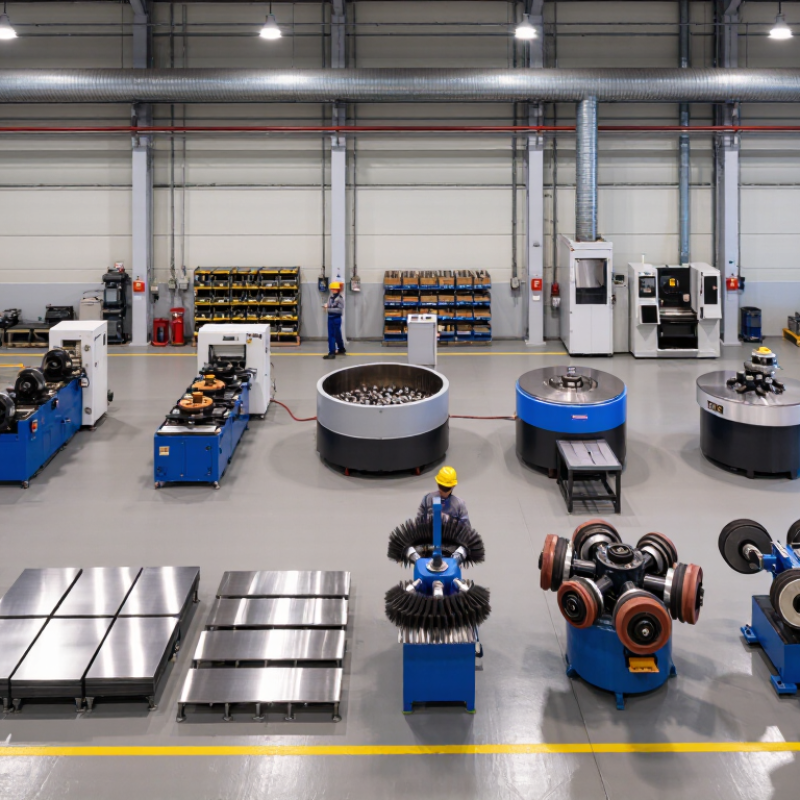
| 1 | Belt Polishing Machine | Fast removal of weld seams, burrs, scale, scratches, and surface irregularities. | An abrasive belt runs over contact wheels or platens and removes material through controlled friction against the workpiece. | Grinding, deburring, satin finishing, blending, and pre-polishing. | Stainless steel, carbon steel, aluminum, brass, copper, and titanium. | Sheet metal, tubes, welded frames, cookware, hardware, and fabricated parts. | High stock-removal rate, flexible abrasive selection, and suitable for flat or contoured surfaces. | Abrasive belts wear over time; operators must control pressure to avoid uneven edges or overheating. |
| 2 | Centerless Polishing Machine | Continuous polishing of cylindrical parts without using a conventional chuck or center support. | A regulating wheel controls rotation and feed while an abrasive wheel contacts the workpiece against a work-rest blade. | Through-feed or plunge polishing, grinding, and fine finishing. | Stainless steel, hardened steel, brass, copper, aluminum, and nickel alloys. | Rods, shafts, pins, tubes, rollers, and other rotationally symmetrical components. | High throughput, consistent roundness, and efficient processing of long cylindrical parts. | Primarily designed for round parts; setup and wheel alignment require skilled adjustment. |
| 3 | Disc Polishing Machine | Polishing flat surfaces, edges, and small components with a rotating abrasive or polishing disc. | A horizontal or vertical disc rotates at controlled speed while the workpiece is pressed against an abrasive or compound-coated surface. | Deburring, edge rounding, surface smoothing, and bright polishing. | Aluminum, stainless steel, brass, copper, steel, and zinc alloys. | Small plates, fittings, sheet edges, hardware, cutlery, and precision components. | Compact design, quick abrasive changes, and good control for localized finishing. | Contact pressure must be controlled carefully; large or irregular parts may be difficult to fixture. |
| 4 | Rotary Barrel Tumbling Machine | Batch deburring, edge softening, cleaning, and general finishing of numerous small parts. | Parts, abrasive media, water, and compounds rotate inside a barrel, producing repeated sliding and impact contact. | Mass finishing, deburring, burnishing, descaling, and cleaning. | Steel, stainless steel, aluminum, brass, copper, zinc, and die-cast alloys. | Fasteners, castings, stamped parts, gears, fittings, and small machined components. | Processes many small parts at once and reduces manual deburring labor. | Parts may contact one another; not ideal for delicate, flat, or highly cosmetic components. |
| 5 | Vibratory Finishing Machine | Mass finishing with improved access to recesses, internal edges, and complex part profiles. | A vibratory bowl or tub oscillates at controlled frequency, causing media and workpieces to rub against each other. | Deburring, polishing, burnishing, radiusing, and oxide removal. | Steel, stainless steel, aluminum, brass, copper, titanium, and zinc alloys. | Precision castings, automotive parts, medical components, fittings, and stamped products. | Good batch consistency, broad media choices, and better treatment of complex geometries than simple barrels. | Processing can take several hours; media separation and wastewater management may be required. |
| 6 | Centrifugal Disc Finishing Machine | Accelerated deburring and polishing for small and medium-sized precision parts. | A rotating disc creates a high-energy toroidal flow of media, compound, and workpieces inside the processing chamber. | Fine deburring, edge rounding, burnishing, and high-speed surface finishing. | Steel, stainless steel, aluminum, brass, copper, and titanium alloys. | Precision machined parts, small gears, connectors, implants, and intricate hardware. | Much faster than conventional vibratory finishing and effective on small complex components. | Higher impact energy can damage fragile parts; batch capacity is generally limited by chamber size. |
| 7 | Electropolishing System | Produces a smooth, clean, and bright metallic surface while removing a controlled microscopic layer. | The workpiece acts as the anode in an electrolytic cell; direct current dissolves surface metal into an electrolyte bath. | Electrochemical smoothing, micro-deburring, brightening, and passivation-supporting surface treatment. | Stainless steel, nickel alloys, cobalt-chromium, copper, and selected aluminum alloys. | Pharmaceutical equipment, food-processing components, laboratory parts, medical devices, and precision tubing. | Improves cleanability and corrosion resistance while reaching some complex internal surfaces. | Requires chemical handling, ventilation, wastewater treatment, and material-specific process control. |
| 8 | Magnetic Abrasive Finishing Machine | Fine finishing and deburring of small parts, narrow channels, holes, and hard-to-reach areas. | A rotating magnetic field moves ferromagnetic abrasive pins through gaps and along the workpiece surface. | Micro-deburring, edge smoothing, polishing, and internal passage finishing. | Steel, stainless steel, brass, copper, aluminum, and non-ferrous precision parts. | Jewelry components, precision fittings, watch parts, small machined parts, and medical components. | Reaches small holes and narrow spaces with short cycle times and minimal fixture requirements. | Limited for large workpieces or heavy stock removal; magnetic-field settings must match part geometry. |
| 9 | Robotic Polishing Cell | Automated and repeatable polishing of large, heavy, or geometrically complex components. | A programmed industrial robot controls tool path, contact force, speed, and orientation using abrasive belts, wheels, or brushes. | Grinding, weld blending, satin finishing, mirror polishing, and multi-stage finishing. | Stainless steel, aluminum, carbon steel, brass, copper, and nickel alloys. | Automotive components, sanitary vessels, large fittings, cookware, furniture parts, and fabricated structures. | Consistent results, reduced operator exposure to dust and vibration, and flexible multi-axis movement. | Higher initial investment; programming, tooling, fixturing, and process integration require technical expertise. |
| 10 | CNC Polishing and Superfinishing Machine | Precision finishing where surface roughness, geometry, and repeatability must be tightly controlled. | Computer-controlled axes guide abrasive tools or polishing heads along programmed paths while controlling feed, pressure, and speed. | Fine grinding, lapping, polishing, superfinishing, and dimensional correction. | Hardened steel, stainless steel, carbide, ceramics, nickel alloys, aluminum, and titanium. | Bearings, hydraulic parts, precision shafts, molds, aerospace components, and high-tolerance tooling. | High repeatability, programmable process parameters, and excellent control of surface texture and form. | Higher purchase and maintenance costs; economical mainly for precision work or medium-to-high production volumes. |