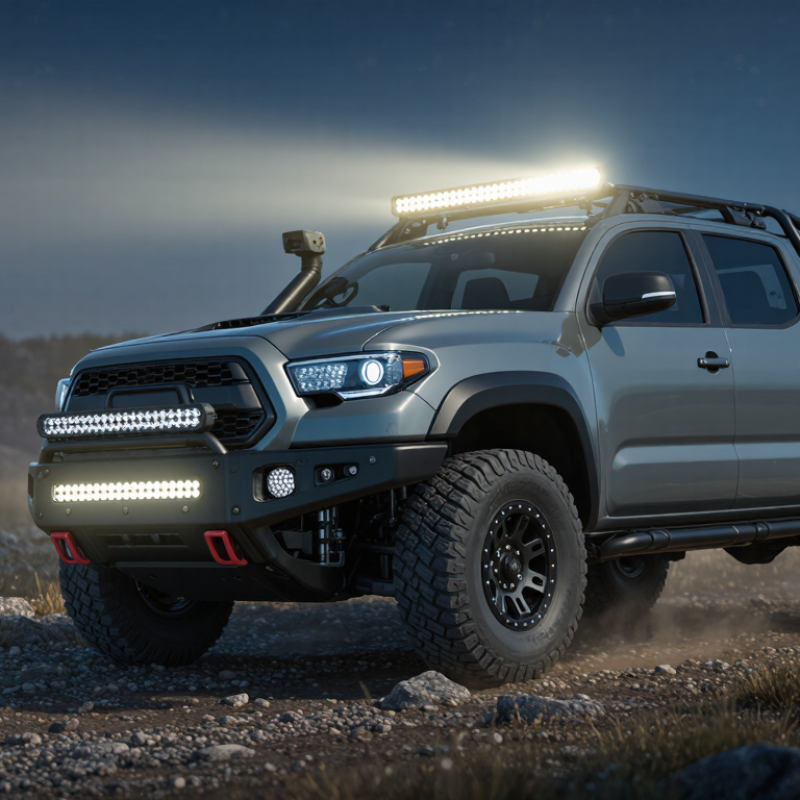
| Auxiliary driving light bar | Supplemental forward lighting for dark rural roads or off-road routes. | Narrow or focused beam designed to project light farther ahead. | SAE J581 | Applies to auxiliary upper-beam driving lamps. A marking or manufacturer declaration should identify the applicable standard and intended lamp function; it is not a universal rating for every light bar. | Use and installation must comply with local rules, including requirements for mounting, aiming, switching, and operation with other vehicle lights. |
| Fog light bar | Low-speed driving in fog, heavy rain, snow, or other conditions where near-road visibility is important. | Wide, low beam intended to illuminate the road close to the vehicle while limiting upward light. | SAE J583 | Sets requirements for front fog lamps. The reference concerns a defined lamp function and performance, not simply brightness or the number of LEDs. | Mounting height, aim, color, and permitted use can be regulated. A wide beam alone does not establish that a lamp meets fog-lamp requirements. |
| Combination spot-and-flood bar | Off-road use where both distance illumination and broad nearby coverage are useful. | Combines a concentrated center beam with wider peripheral light. | No single SAE reference applies to every combination bar | Check the declared function and any specific standard marking. A combination beam or high lumen figure does not, by itself, demonstrate SAE conformity. | Many off-road auxiliary bars are not intended for use on public roads. Cover or switch them off where required by local law. |
| Off-road flood bar | Work areas, trails, campsites, and close-range vehicle surroundings. | Broad, dispersed beam that spreads light over a wide area. | No single SAE reference applies to every off-road flood bar | SAE does not provide one general-purpose certification covering all off-road LED light bars. Verify any standard claimed for the specific lamp and its intended use. | Wide-area output can cause glare for other road users. Treat as work or off-road lighting unless the lamp is specifically approved and installed for road use. |
| Flashing warning light bar | Warning or signaling applications on vehicles authorized to use such equipment. | Flashing or other warning-light output; not intended as a driving beam. | SAE J595 or SAE J845, depending on device type and application | These references address specified warning-light performance. They are distinct from standards for forward driving or fog lamps. | Warning colors and flashing lights are restricted in many jurisdictions and may be limited to authorized vehicles or specific uses. |
| Testing and verification | Assessing lighting equipment against the applicable performance and durability requirements. | Not a beam category; applies to test methods and equipment evaluation. | SAE J575 | Provides test methods for certain automotive lighting devices. It is not, by itself, a general product approval or a guarantee of road legality. | Confirm the applicable standard, edition, product documentation, and vehicle regulations rather than relying on the word “SAE” alone. |
| Important: “SAE certified” is not a single, universal certification for all LED light bars. SAE standards are specific to lamp functions and performance requirements, and SAE publishes standards rather than granting blanket approval to every product that cites them. Lumens, beam pattern, standard conformity, and legal road use are separate considerations. In the United States, vehicle lighting requirements may also involve federal rules such as FMVSS No. 108 and applicable state or local laws. |