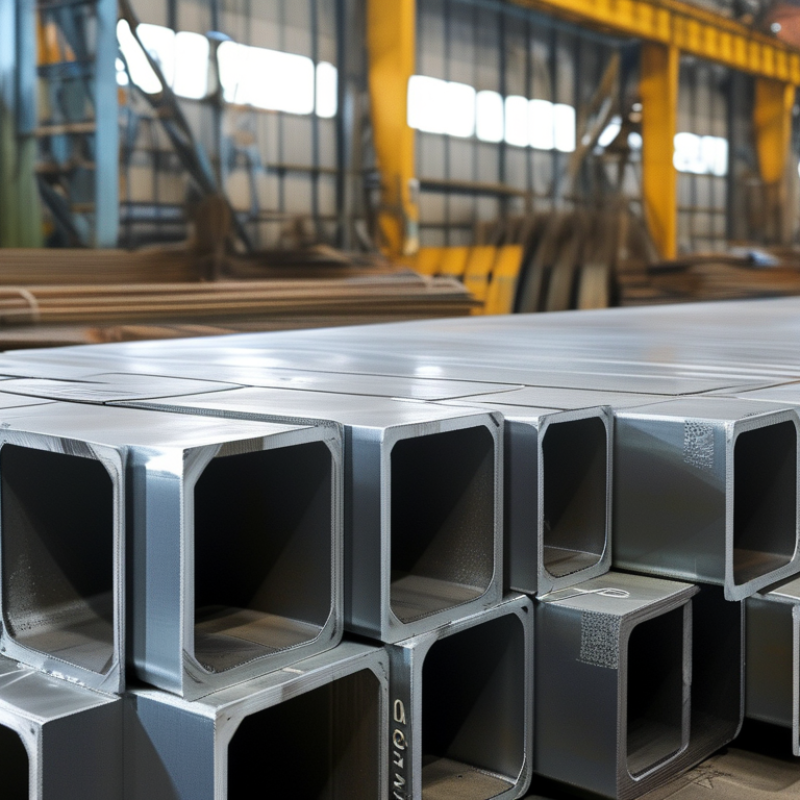
| Product Standards | Applicable structural hollow-section standard | ASTM A500/A500M for structural tubing or EN 10219 for cold-formed welded structural hollow sections | Mill test certificate, product specification, third-party inspection report | Confirms that dimensions, mechanical properties, testing, and acceptance criteria match the project specification. |
| Steel Grade | Minimum yield strength and tensile strength | ASTM A500 Grade B: minimum yield strength of approximately 315 MPa and tensile strength of approximately 400 MPa; ASTM A500 Grade C: approximately 345 MPa yield and 427 MPa tensile strength | Heat number traceability, chemical analysis, tensile test results | Higher verified strength can support structural performance and reduce the risk of unsuitable substitutions. |
| European Grade Option | Structural grade for EN-based projects | S355J2H commonly provides a minimum yield strength of 355 MPa for wall thicknesses up to 16 mm, subject to the applicable standard and thickness | EN 10219 inspection certificate, Charpy impact test results, grade declaration | Helps buyers align the tube grade with European structural design and documentation requirements. |
| Outside Dimensions | Square outside width and height | Common commercial sizes range from approximately 20 × 20 mm to 500 × 500 mm; project-specific tooling may be required outside standard mill ranges | Approved dimensional drawing, calibration records, inspection report | Matching available mill sizes can reduce tooling charges, production delays, and minimum-order constraints. |
| Wall Thickness | Nominal wall thickness availability | Typical commercial ranges are approximately 1.2–25 mm, depending on outside size, steel grade, forming method, and applicable standard | Thickness inspection records, ultrasonic or micrometer readings, tolerance statement | Wall thickness affects load capacity, weight, welding behavior, corrosion allowance, and shipping cost. |
| Dimensional Tolerance | Permitted variation in outside dimensions and wall thickness | Typical structural-tube requirements may include outside-dimension tolerances around ±0.75% under ASTM A500 and wall-thickness tolerances around ±10%; always confirm the selected standard | Standard-specific tolerance table, in-process inspection data, final inspection report | Consistent tolerances are essential for modular construction, tight-fit fabrication, and automated assembly. |
| Straightness and Squareness | Tube straightness, corner radius, and twist | Use the project standard and approved drawing; corner radius and twist should be stated when the product is used for precision fabrication | Inspection plan, profile measurements, sample approval, dimensional test report | Controls fit-up problems, excessive welding gaps, and installation rework. |
| Surface Condition | Surface finish and defect control | Black, pickled, oiled, galvanized, or painted finishes; visible cracks, laminations, severe dents, and unacceptable weld defects should be rejected | Surface inspection criteria, welding procedure, repair procedure, photographs before shipment | Surface quality influences corrosion protection, appearance, weldability, and downstream coating performance. |
| Corrosion Protection | Galvanizing or coating system | Hot-dip galvanizing should be specified by the applicable coating standard, coating thickness or mass, surface preparation, and repair requirements rather than by appearance alone | Coating thickness readings, galvanizing certificate, paint data sheet, salt-spray or adhesion results when required | Clear coating requirements help buyers compare service life and total installed cost across suppliers. |
| Weld Quality | Longitudinal weld integrity and testing | Define weld acceptance criteria and testing method, such as visual inspection, eddy-current testing, ultrasonic testing, or hydrostatic testing where specified | Welding procedure specification, welder qualification, non-destructive testing report | Verified weld quality lowers the risk of leakage, cracking, fatigue failure, and fabrication rejection. |
| Chemical Composition | Carbon, manganese, phosphorus, sulfur, and alloy content | Chemical limits must follow the selected grade and standard; low-carbon compositions are generally preferred when welding requirements are demanding | Heat analysis, product analysis, material safety documentation | Chemistry affects weldability, strength, toughness, corrosion behavior, and compliance with local regulations. |
| Mechanical Testing | Tensile, yield, elongation, and impact performance | Testing frequency and minimum values should follow the specified standard; impact testing is particularly relevant for low-temperature service | Certified mechanical test results linked to heat numbers and production batches | Batch-level testing provides measurable evidence that the delivered material meets the agreed performance level. |
| Quality Management | Production and quality-control system | An ISO 9001-certified quality-management system is a useful baseline, but certification should be supported by process records and corrective-action evidence | Valid certificate, audit report, inspection and test plan, nonconformance records | A documented system improves repeatability, traceability, complaint handling, and corrective action. |
| Traceability | Link between finished bundles and original steel heats | Each bundle should carry size, grade, standard, quantity, heat number, production date, and batch identification | Bundle labels, packing list, heat-number map, mill test certificate | Traceability simplifies customs clearance, project approval, recalls, and investigation of quality issues. |
| Production Capacity | Monthly output and line capability | Assess capacity by size range, wall thickness, grade, finish, and available production lines rather than by total annual tonnage alone | Capacity statement, equipment list, recent production schedule, factory audit | A partner may have high total capacity but limited capability for a buyer's specific size or grade. |
| Minimum Order Quantity | MOQ by size, grade, finish, and production batch | MOQs vary by mill setup and material; buyers should request separate quantities for trial orders, standard production, and custom tooling | Formal quotation, production-batch policy, tooling quotation | Clear MOQ information prevents unexpected setup fees and helps optimize inventory planning. |
| Lead Time | Order confirmation to shipment | For standard sizes, a realistic quotation should separate raw-material procurement, production, inspection, packing, and port delivery time | Manufacturing schedule, production milestones, historical on-time-delivery data | Transparent lead-time planning reduces project delays and allows buyers to compare suppliers fairly. |
| Packaging and Loading | Bundle weight, protection, and container utilization | Use strapped bundles with moisture protection and clear labels; confirm maximum bundle weight, container loading plan, and corrosion-prevention method | Packing specification, loading photographs, container plan, packing list | Proper packaging reduces transit damage, handling risk, moisture corrosion, and documentation errors. |
| Export Documentation | Completeness of shipping and compliance documents | Typical documents include commercial invoice, packing list, bill of lading, certificate of origin, mill test certificate, and inspection certificate when required | Sample document set, document-control checklist, export compliance declaration | Complete documentation supports customs clearance, payment release, and project handover. |
| Inspection Option | Independent pre-shipment inspection | For critical projects, specify sampling level, inspection stage, test scope, and acceptance criteria before production begins | Approved inspection and test plan, third-party report, sealed samples, corrective-action record | Independent verification reduces information asymmetry and provides stronger evidence in international transactions. |
| Commercial Evaluation | Total landed cost rather than unit price alone | Compare material price, tooling, testing, coating, packing, inland transport, ocean freight, duties, insurance, and potential rejection costs | Itemized quotation, Incoterms, freight assumptions, duty classification, payment terms | The lowest factory price may not produce the lowest delivered cost or the lowest project risk. |