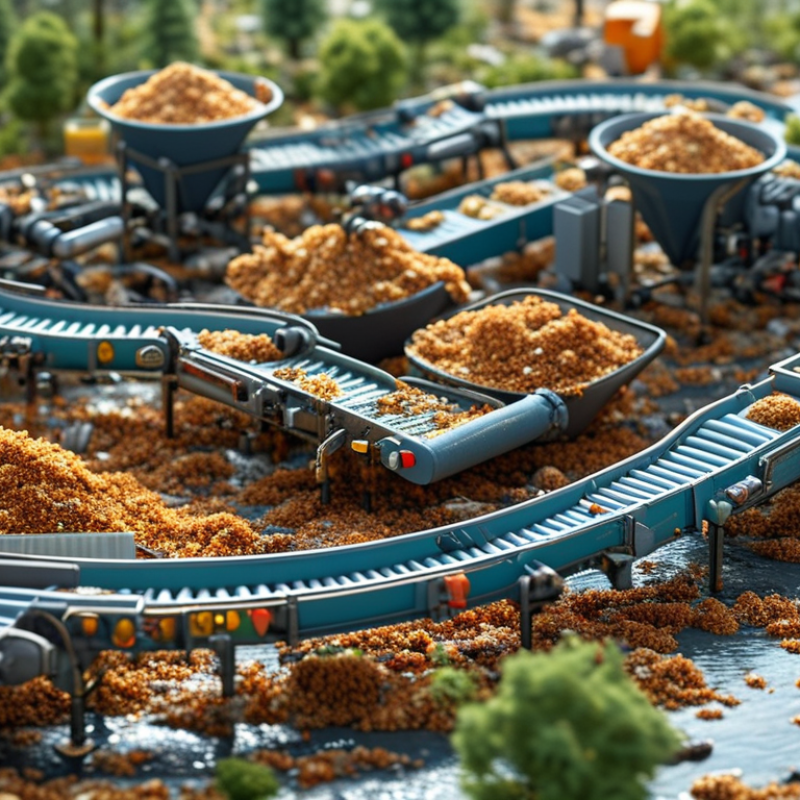
| Definition | Waste feeding system | Transfers prepared waste from storage or processing equipment to a treatment unit, such as a furnace, boiler, gasifier, or anaerobic digester. | Enclosed mechanical equipment with conveyors, hoppers, chutes, and control devices. | The system must provide a controlled, continuous, and safe feed despite variations in waste size, moisture, and composition. |
| Receiving and storage | Receiving hopper or bunker | Collects incoming waste and provides a buffer between delivery and the treatment process. | Reinforced steel, concrete bunker walls, abrasion-resistant liners, and sealed access areas. | Capacity is selected according to delivery frequency, treatment throughput, and required operating reserve. |
| Metering | Dosing hopper or metering bin | Regulates the amount of waste released into the conveying or feeding line. | Steel hopper with a variable-speed screw, belt, apron, or hydraulic extraction device. | Accurate metering helps maintain stable thermal output, residence time, and downstream process conditions. |
| Conveying | Belt, apron, screw, or chain conveyor | Moves waste from the storage area or preparation stage to the final feeder. | Carbon steel or stainless steel frames, heavy-duty chains, sealed bearings, and replaceable wear parts. | The conveyor type depends on waste density, particle size, moisture, inclination, and risk of wrapping or bridging. |
| Size reduction and preparation | Shredder, crusher, or pre-processing unit | Reduces oversized items and improves feed uniformity before the waste enters the treatment equipment. | Slow-speed or high-torque cutting equipment with replaceable knives, screens, or breaker bars. | Foreign objects, long flexible materials, and excessive moisture can affect throughput and increase blockage risk. |
| Final feeding | Ram feeder, rotary valve, screw feeder, or hydraulic pusher | Delivers waste into the reactor, furnace, boiler, or digester at a controlled rate. | Hydraulic cylinders, abrasion-resistant steel, rotary pockets, or enclosed screw flights. | The feeder must tolerate heat, abrasion, pressure differences, and potential backflow from the treatment chamber. |
| Air and odor control | Seals, extraction fan, and air-lock arrangement | Limits the escape of dust, odors, smoke, and process gases while maintaining controlled airflow. | Flexible seals, enclosed transfer points, induced-draft fans, and mechanical or rotary air locks. | Negative pressure is commonly used in waste handling areas to direct contaminated air toward treatment or filtration equipment. |
| Monitoring | Level, weight, speed, temperature, and blockage sensors | Measures operating conditions and detects empty, overloaded, overheated, or obstructed equipment. | Load cells, radar or ultrasonic level sensors, encoders, thermocouples, and vibration switches. | Sensor selection should reflect dust, moisture, corrosive gases, temperature, and the required measurement accuracy. |
| Control system | PLC, variable-frequency drives, and operator interface | Coordinates start-up, shutdown, speed control, alarms, interlocks, and automatic feed-rate adjustment. | Industrial control cabinet, programmable logic controller, motor drives, and human-machine interface. | Interlocks should prevent feeding when downstream equipment is stopped, blocked, overheated, or not ready. |
| Safety | Emergency stops, guards, access controls, and fire protection | Protects personnel from moving machinery, fire, hot surfaces, dust, and unexpected start-up. | Guarding, pull-cord switches, emergency-stop buttons, fire detection, water or inert-gas systems where appropriate. | Safety measures must be selected through a documented risk assessment and maintained throughout the equipment lifecycle. |
| Operating sequence | Receiving → preparation → metering → conveying → final feeding → treatment | Creates a continuous material path from waste intake to the treatment chamber. | The exact arrangement varies with waste type, treatment technology, site layout, and required capacity. | A reliable system balances throughput, feed consistency, energy use, maintenance access, containment, and process safety. |