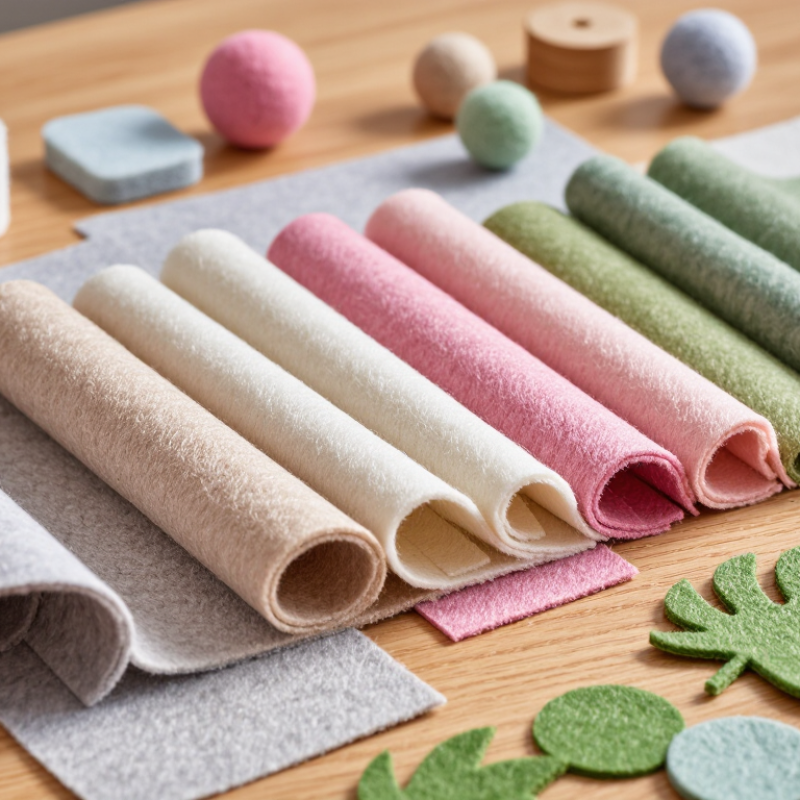
| Definition | A nonwoven textile made by interlocking wool fibers with other fibers, commonly synthetic fibers such as polyester or acrylic. | The blend combines some of wool’s natural texture and warmth with improved consistency, durability, or cost control. |
| Fiber Composition | Common ratios include approximately 20–80% wool, with the remaining portion made from one or more manufactured fibers. Actual ratios vary by product. | Fiber content affects softness, heat response, strength, appearance, price, and care requirements. |
| Manufacturing Method | Fibers are layered and mechanically entangled through processes such as needling, moisture, heat, and pressure rather than being woven or knitted. | The resulting material has no conventional warp-and-weft structure and can be cut without typical woven-fabric fraying. |
| Common Thicknesses | Craft sheets are often about 1–3 mm thick; industrial grades may be substantially thicker or supplied in rolls, pads, or molded forms. | Thickness influences stiffness, cushioning, insulation, edge appearance, and suitability for sewing or fabrication. |
| Surface and Hand Feel | Usually soft, slightly textured, and matte, with a dense or semi-dense surface depending on fiber blend and production method. | Its tactile surface is useful for decorative products, protective linings, acoustic treatments, and touch-sensitive designs. |
| Dimensional Stability | Generally stable during ordinary handling, although excessive heat, moisture, agitation, or pressure can cause wool-containing felt to shrink or distort. | Designers should test the exact material before washing, steaming, heat-forming, or using it in tight-fitting applications. |
| Craft Applications | Appliqué, ornaments, soft toys, dolls, brooches, garlands, banners, book covers, gift packaging, and decorative wall pieces. | It is easy to cut, glue, hand-stitch, machine-stitch, layer, and shape for small creative projects. |
| Interior and Product Design | Pinboards, desk organizers, storage baskets, lampshade components, decorative panels, furniture accents, and protective case interiors. | The material adds texture and can help cushion surfaces or reduce minor contact noise. |
| Industrial Uses | Gaskets, seals, spacers, polishing pads, vibration-damping layers, filtration components, and protective interlayers. | Dense felt can provide compression, cushioning, friction control, and limited sound or vibration reduction. |
| Acoustic Applications | Wall tiles, ceiling elements, desk screens, room dividers, and decorative acoustic panels. | Porous felt surfaces can absorb some reflected sound, but performance depends on thickness, density, air gaps, and installation. |
| Thermal Behavior | Wool fibers can provide warmth and some natural resistance to ignition, while synthetic fibers may melt, shrink, or behave differently when exposed to heat. | Fire performance must be verified for the specific blend and tested product; wool blend felt should not automatically be treated as fireproof. |
| Cutting and Joining | Can be cut with fabric scissors, rotary cutters, dies, or industrial cutting equipment; common joining methods include sewing, riveting, adhesive bonding, and lamination. | The best method depends on thickness, load, edge visibility, and whether the finished item must flex or withstand abrasion. |
| Care Requirements | Many wool blend felt products are best spot-cleaned with cool water and mild detergent; vigorous washing and high heat are commonly unsuitable. | Care instructions should be based on the actual fiber ratio, finish, adhesive, backing, and intended use. |
| Key Advantages | Soft texture, easy fabrication, low fraying tendency, good compressibility, visual warmth, and potential sound-absorbing qualities. | These features make it suitable for both decorative products and selected functional components. |
| Important Limitations | Performance can vary widely by blend, density, finish, and backing; some grades may pill, absorb moisture, shrink, or have limited abrasion resistance. | Material samples and application-specific testing are recommended before use in safety-critical, outdoor, high-temperature, or heavily loaded products. |